


By Capt. Lee Noga, Founder, MacDaddy Fishing Lights
Fishing lights for crappie and striped bass setups fail for one reason more than any other: anglers assume more lumens means more fish. It doesn’t. Crappie and striped bass hunt the same way after dark as visual, schooling ambush predators and both respond more to where the light is placed and how it’s controlled than to raw brightness. Get the placement right and you’ll out-fish someone running a brighter light in the same spot.
What people overlook when deciding which species they’re targeting is whether the fishing light for crappie and striped bass is light-tolerant or light-intolerant.
Here’s the setup that actually works, and why and what actually separates a good fishing light for crappie and striped bass from a light that sits in the water doing nothing.
Why Crappie and Striped Bass Respond to Light the Same Way

Different size, different water, same playbook. Crappie hold around brush piles, submerged timber, and dock pilings. Striped bass patrol open-water current channels and bridge pilings. But both are nocturnal, sight-based hunters that key in on baitfish silhouetted against light, which is why the same light strategy works for both, even though you’ll fish them differently once the light’s in the water. That overlap is exactly why a single fishing light for crappie and striped bass can cover both species without compromising on either.
Dual-Color Light: Why Green and White Do Different Jobs
Crappie and stripers are both hunting the same thing at night: dense pods of shad, minnows, or glass minnows.
Green light cuts through murky lake or river water and quickly triggers plankton aggregation; that’s the first domino. Plankton draws shad and minnows, and the bait shows up.
White light does something green can’t: it adds visual depth to the water column. Once bait stacks up under green light, a white LED strip lets you actually see the deeper, larger silhouettes of stripers moving beneath the bait ball, which matters, because you fish those two species differently depending on whether you can see them or you’re fishing blind.
Running both in one housing (Macdaddy lights), which is what a dual-mode light gives you, means you’re not choosing one job over the other. For the full wavelength science behind why green outperforms white in stained water and where white actually wins, click our blog article breakdown of green vs white fishing light color.
The Bait Blackout Problem (and How Strobe Modes Fix It)
The most common failure in crappie/striper night fishing isn’t the wrong light; it’s a bait blackout, and it’s the single biggest reason a fishing light for crappie and striped bass gets blamed for “not working” when the light itself is fine. Thousands of baitfish swarm a bright underwater light and pack in so densely they physically block the light from reaching past them. From the surface, it looks like the light died. What actually happens is the predator fish lose interest because they can’t see through a solid wall of bait, so they leave.
The MacDaddy Smart Light strobe mode briefly disrupts the bait ball at a set patented frequency, scatters the pod just enough to open the light field back up, and the sudden scatter itself often triggers a reaction strike from stripers or crappie sitting nearby, since a scattering bait ball reads to them as a predator already attacking.
This picture is saltwater catfish dominating the light field during the shrimp run. The light is what attracts the junk catfish. Baitfish blackout can end your night due to blocking your illumination 100%.

Anchoring Matters More Than People Think
Crappie key on structure, brush piles, timber, dock pilings. Stripers key on current channels. Neither species tolerates a light that sways, which is why anchoring is non-negotiable for any fishing light for crappie and striped bass, not an optional accessory.
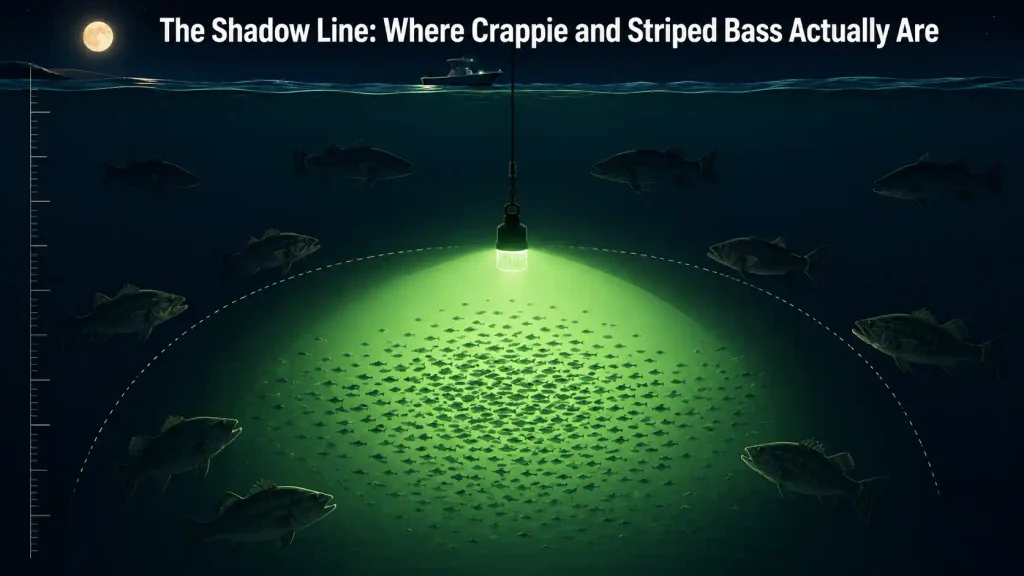
An unanchored light swinging in the wind, hanging off the side of a boat, or moving with the tide current spooks both species; fast, erratic movement reads as danger, not food. A proper flotation-top-and-bottom-anchor setup keeps the light hanging dead vertical in the water column, which does two things: it holds a stable illuminated zone (a well-anchored light can build a bait zone 18+ feet across), and it keeps unlit water directly above the light, which is where the predator fish actually want to sit. This behavior, placing them in stealth mode, was created by the patented MacDaddy Smart fishing light.
The Shadow Line: Where the Fish Actually Are – OLD WAY
Capt. Lee Noga believes: one light should be able to catch ALL things, whether freshwater, saltwater, or ice fishing. Popular light-sensitive species include shrimp, snook, tarpon, speckled trout, redfish, crappie (black/white), bass (largemouth/smallmouth), and walleye. You should be able to use your light in every fight and enjoy a year-long season chasing species with consistent results.
BOTTOM UP LIGHTING (stealth mode) – The MacDaddy Total System
Predator fish rarely sit in the bright center; they hold on the shadow line and in the dark water above the light. From a cause-and-effect standpoint, the cause of hanging out on light edges is UNCONTROLLED LIGHT, and the effect is that they hang around the darker edges of the offending light field.
MacDaddy creates several feet of unlit water above the light through anchoring and backlighting; the normal ecosystem responds in real time in your view. You can see predator fish responding to bait fish. You see light, and the fish see unlit water. That is the MacDaddy fishing lights magic. Stealth mode is backlighting; this big fish is backlit from the light set at the proper depth using a formula. The water above the light is unlit.

MacDaddy Backlights Targets Giving You A Window Into Ecosystem Without Needing Cameras

Note – The predator fish is not excitable, thrashing, sensing, or in danger. The bait are calm; they are also not excitable, and they are going about their night as they do, feeling safe. We have a predator, and we have bait; this is what it looks like in their environment at night. Backlighting them gives us a non-offensive window into their environment without using scuba gear and tanks.
This is the beauty of witnessing life underwater and seeing their world without disruption. Solving this problem of how we coexist with the marine environment was the question that brought Capt. Lee Noga to the water for answers. The perfect light needs to give us eyes in their environment while letting us manipulate the biologicals with light frequencies toward our nets and lines without disrupting their ecosystem. This research earned Capt. Lee Noga the first patented smart light that can catch all species in any type of water.
MacDaddy fishing lights were built 5 years after Capt. Lee Noga made one of the biggest discoveries in night fishing. Consumers asked her to build the perfect fishing light. Her best friend asked, if she helped with the financing, manufacturing, etc., would I do it? How could I not? She did innovate the perfect fishing lights, and MacDaddy fishing lights were on the river in 2016.
Capt. Lee Noga took the sport of shrimping, once considered the most difficult sport to hunt, and turned it into Florida’s winter vacation destination. The science she took Public (full transparency) is the biggest contribution to night fishing in the 21st century. Her proven methods catch ALL species that thrive in 50 feet of water or less.

Predatory fish rarely sit in the brightest center of the light. They hold on the shadow line, the edge where light fades into darkness. STOP RIGHT THERE. This was 100% the gold standard for 100 years.
The technological advancements added a second fact, based on Capt. Lee Noga’s 2012 research.
It should read as of 2012: “They hold on the shadow line, the edge where light fades into darkness, or in the unlit water directly above the light.” Meaning we cannot generalize fish as only looking for edges; we must acknowledge they seek unlit water when a fishing light is deployed, using proven science, if they are light intolerant.
If that were not true, how are thousands of anglers so successful with the MacDaddy science?
Bottom line: all you need is 3000-6000 lumens to backlight; you don’t need to disrupt the ecosystem. Capt Lee Noga proved less is more and found the path to introduce light into a nighttime environment without disrupting the natural ecosystem. Following this discovery, she built a training program to transition anglers into science without making it technical or complex.

Fishing Light for Crappie and Striped Bass: The Two Setups

Same light, two different approaches, because these species hunt differently even in the same water.
Crappie: Vertical Jigging the Shadow Line
Crappie sit directly under the bait cloud or hold on the outer edge of the light ring.
- Setup: Position the light 2 to 4 feet above a known brush pile, drop-off, or dock piling.
- Cast: Drop your jig 5 to 10 feet past the light ring, into total darkness.
- Retrieve: Let it sink to light depth, then work it slowly into the outer edge of the green glow.
- Best method if you’re on a boat or dock: Skip the cast entirely. Drop straight down at the shadow line, let the jig sink below the light, then jig upward into the bottom edge of the glow.
Striped Bass: Ripping Through the Light Cone
Stripers are faster, more aggressive hunters; they circle the light’s perimeter and blast through the center to scatter bait.
- Cast: 15 to 20 feet out, well past the light’s radius, into open darkness.
- Retrieve: Steady, medium pace, the lure should travel out of the dark, cut through the brightest center of the light, and disappear back into darkness on your side.
- The strike window: Right at the transition, the exact second the lure crosses from dark into light, or light back into dark. That’s when a striper commits.

Jig Color and Weight
Green and white wavelengths shift how lure colors actually look underwater, so match your jig to the light, not to daylight habits; this is a step most guides to buying a fishing light for crappie and striped bass skip entirely.
- Crappie: Chartreuse/white, pink/white, or clear glitter 1/16 to 1/32 oz. These colors glow noticeably under green light.
- Striped bass: White or pearl paddle-tail swimbait, 3–5 inches, on a 1/4 to 1/2 oz jighead. White silhouetted against green light reads as a wounded shad.
One mistake to avoid: don’t drop your jig into the dense center of the bait ball. Your line will constantly tangle with baitfish, spook the school, and cost you hookups. Fish the top of the water column above the light; you see the green glow, the fish see dark water, and that’s exactly the setup you want.
What We’re Hearing From Anglers Running This Setup
Field feedback and support conversations around this setup keep pointing to the same handful of results, and they consistently reinforce what actually matters when choosing a fishing light for crappie and striped bass:
- Stealth output matters more than raw brightness. Anglers who dial output to the 3,000–6,000 lumen range instead of maxing out report crappie and stripers holding calm on the shadow line instead of scattering.
- Strobe modes solve bait blackout reliably. When the bait ball gets too dense to see through, a short strobe pulse breaks it up and reliably draws a reaction strike from nearby predators.
- Anchoring stability changes results in wind and current. A stable, vertically-anchored light holds a consistent bait zone; an unanchored light that sways loses fish fast.
- Dual-color setups solve the green-vs-white debate by letting you choose both. Green pulls in the plankton-to-baitfish chain; white gives visibility on the larger fish moving underneath.
FAQs
What’s the best fishing light for crappie and striped bass?

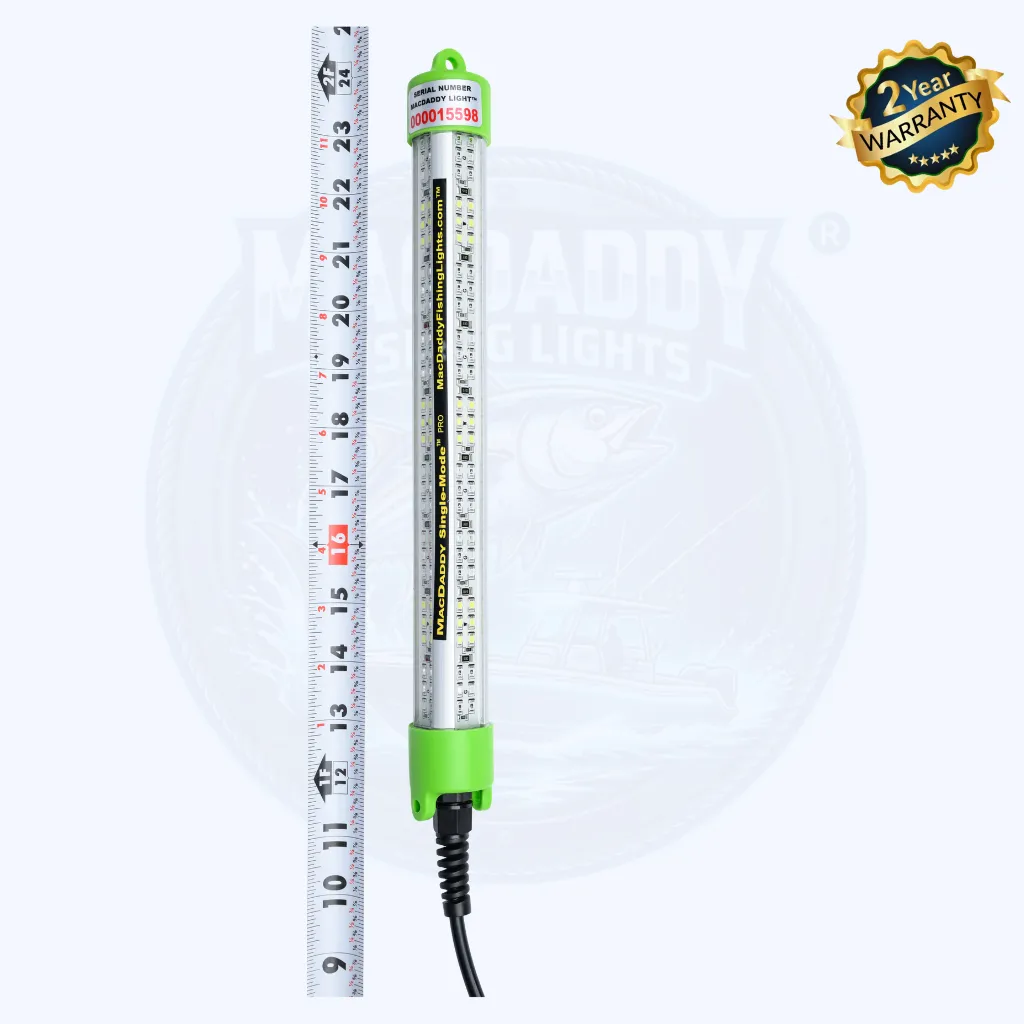
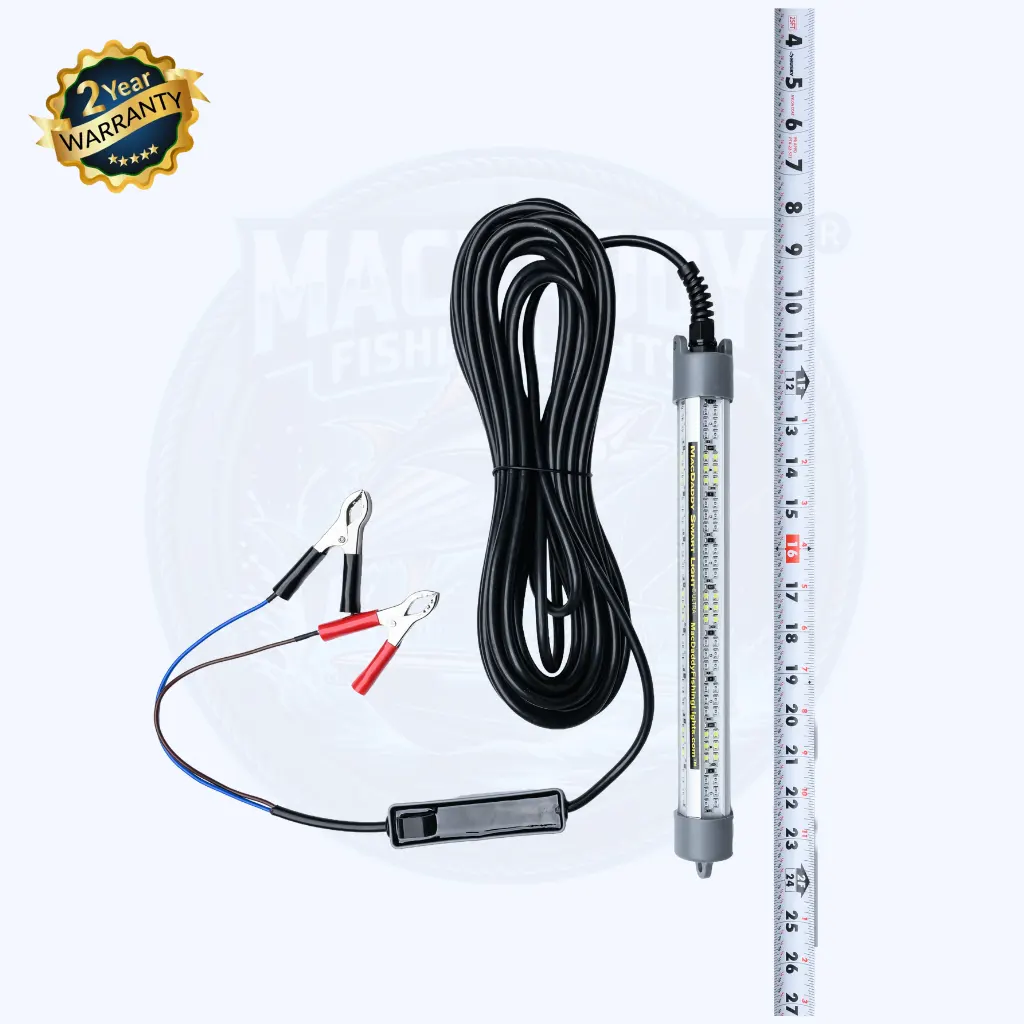
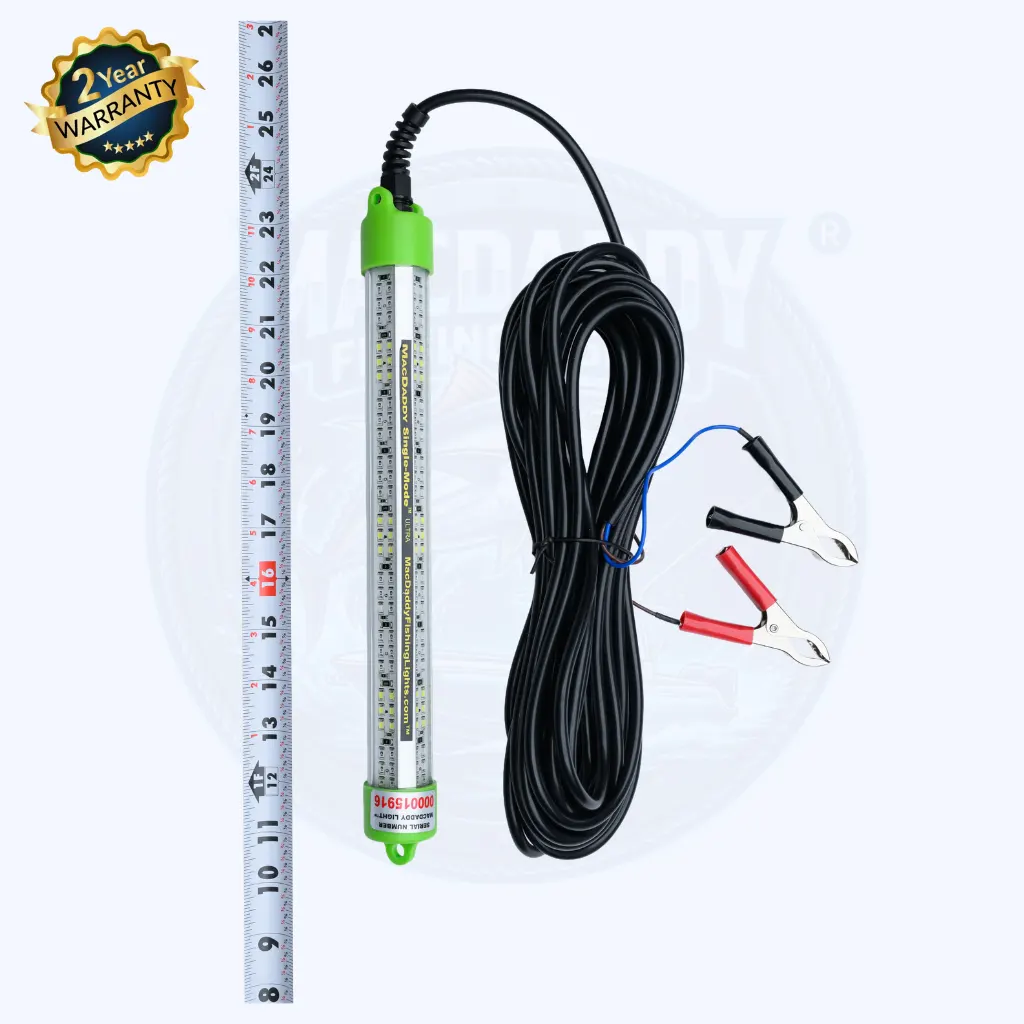
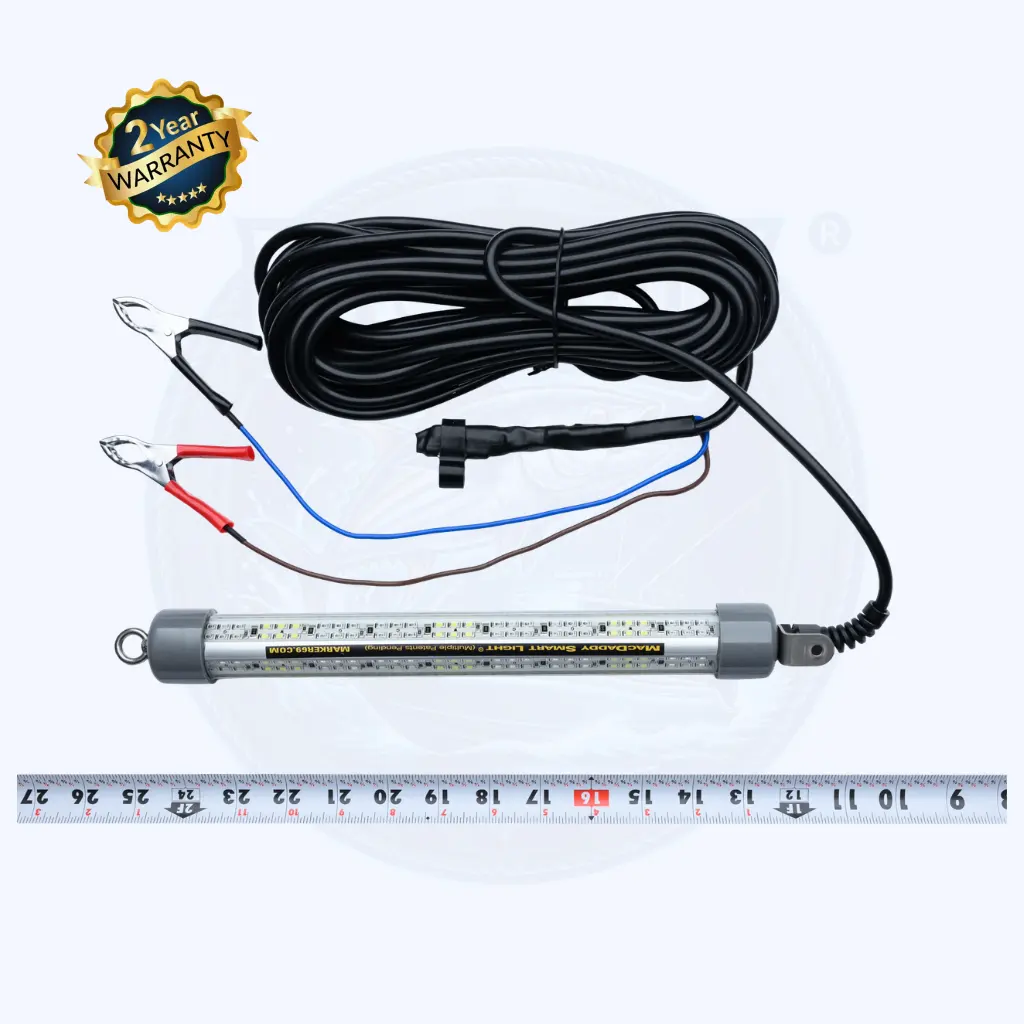
A dual-color (green and white) submersible light with adjustable or strobe modes, anchored vertically rather than left to swing freely. Green draws the plankton-to-baitfish chain; white adds visibility on larger fish below. MacDaddy fishing lights are built for all fishing seasons and all types of water. Educational program and 2-year warranty,
Where do crappie and striped bass actually sit around a fishing light?

On the shadow line, the edge where light fades to dark, or in the unlit water directly above the light. Fish rarely hang out in the brightest center. MacDaddy Stealth-mode: biggest breakthrough in night fishing. Creates an ecosystem backlighting the targets, giving you a direct visual into the ecosystem without the need for sonar or cameras. You see them, and they do not see you. Hence, the name stealth mode.
How many lumens do I need for crappie and striped bass fishing?

Less than you’d think. 3,000–6,000 lumens for stealth mode; excessive brightness pushes fish away from the light rather than holding them close. MacDaddy fishing lights create a natural environment above the light in unlit water created by our proprietary depth-setting formula, Depth-8=X, with NO light disruption. YOU see the fish; they do not see you. Manatees stay away from boats; this cow popped out from under the boat because it is swimming in unlit water above the MacDaddy lights set in stealth mode. It didn’t see the boat.
What is a bait blackout and how do I fix it?

It’s when a bait ball gets so dense it blocks the light from projecting outward, causing predator fish to lose interest and leave. A brief strobe pulse scatters the bait just enough to reopen the light and often triggers a reaction strike. MacDaddy smart light was awarded the highest utility patent for innovation; it is the only patented smart fishing light in the USA.
PATENTS Awarded: MacDaddy Fishing Lights® is protected by U.S. Utility Patent 11,147,263 and 8 U.S. design patents.
What color jig works best under a green fishing light?

For crappie: chartreuse/white, pink/white, or clear glitter. For striped bass: white or pearl paddle-tail swimbaits, both read clearly against a green-lit background.
Do I need to anchor my fishing light, or can I just drop it over the side?

Anchor it if you’re using the MacDaddy fishing light deployment system. An unanchored light that sways in wind or current spooks both species. A flotation-top-and-bottom-anchor setup holds the light vertical and keeps the bait zone stable. MacDaddy lights have been in a focus research group for 12 years. These lights were built to handle anchor stress in harsh tidal conditions.

Patent Declarations:
PATENTS Awarded: MacDaddy Fishing Lights® is protected by U.S. Utility Patent 11,147,263 and 8 U.S. design patents.
Recommended Links:
Shop The MacDaddy Fishing Lights® Online Store
View 60-second Demo – MacDaddy Fishing Lights® Smart Light ULTRA 8-modes
View/Download – MacDaddy Fishing Lights® Light Deployment Strategies Manual
View YouTube® 2026 Master Class Video – Stop Setting Your Fishing Lights Wrong
Recommended Articles
Why More Excessive Lumens Kill Night Fishing Success
How To Setup Lights For Maximum Efficiency Chasing Shrimp
The NEW Argument: Headlight vs. Fishing Light. The Winner Is ….
Green vs. White vs. Dual Color Fishing Lights
Toy? Tool? Toolbox? What Fishing Light Do I buy?