

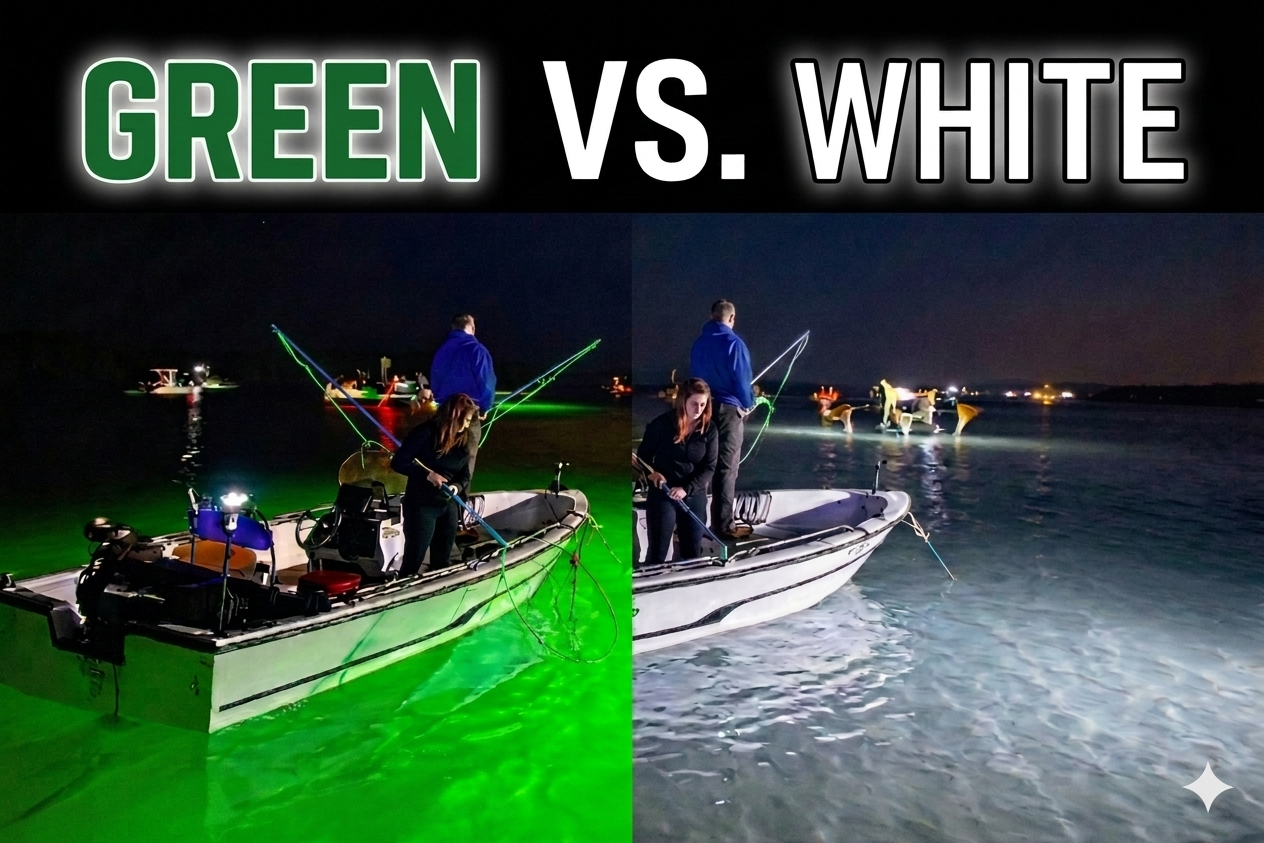
You want to buy the right LED fishing light. The internet is telling you green is the best kind. Your buddy swears by white. Someone in the Facebook group is using a multi-colored green/white. So which color lights actually work, and what does the science say?
The debate over fishing light color has been running for years, and for most of that time, it has been driven by marketing “hype” rather than data. At MacDaddy Fishing Lights®, we have spent over a decade testing light presentations in Florida’s tidal waters, and the answer is more involved than “just use white or green.” Let’s break it down.
Water is not a neutral medium. Different wavelengths of light travel through water at different rates and are absorbed at different depths. What looks bright on the surface may be nearly invisible to a shrimp hovering six feet below.
Here is what physics tells us:
Consensus: Red and amber lights are not recommended for underwater fish attraction because they lose brightness quickly, whereas colors like green and blue can penetrate much deeper into the water.
Light does not attract fish directly. It triggers a food chain reaction (takes 15 to 45 minutes). Plankton are far more attracted to the higher frequencies and longer-reaching wavelengths of light. This is where green and white lighting are the best choices inshore, rather than amber or red.
Here is how it works:
Phytoplankton and microscopic organisms are drawn to the light source first. Baitfish, shrimp, glass minnows, and pilchards follow to feed on the plankton. Predatory fish arrive to feed on the baitfish. The angler intercepts the predators.
The green light is highly visible to the organisms at the bottom of this chain. That is why it consistently outperforms other colors for attracting bait density. More bait stacked tightly around your light means more predators on patrol, and more opportunities for the angler.
White light is not without value. It excels in specific situations:
The mistake anglers make is treating white light as a substitute for green rather than a complement to it. They are not the same tool.
Here is where it gets interesting. Field research conducted by Capt. Lee Noga, the innovator behind MacDaddy Fishing Lights®, revealed something the color debate had been missing entirely: the ability to switch between green and white or run both simultaneously is more powerful than either color alone.
The MacDaddy Fishing Lights® entire line features both green and white LEDs in a single unit. This matters for two specific reasons:
Tidal water conditions in Central Florida change night to night. Water clarity, turbidity, baitfish density, and ambient moonlight all shift the optimal color presentation. A light locked into one color cannot adapt. A dual-mode system allows the angler to read the conditions and respond with the right tool.
The 2015 MacDaddy Smart Light® series patented frequency strobe mode alternates green and white LEDs at a precise frequency. At approximately 2Hz, this patent-protected strobe pattern does something no single-color steady light can replicate: it causes shrimp to boil to the surface, and at our patented proprietary higher frequency actively disrupts catfish bait blackouts by breaking up dense bait pods. This is not a light trick. It is a proven, patented science that is now the gold standard in night fishing. It has been scientifically validated as a tool for manipulating marine life behavior. No competitor can offer this; it would violate our protected utility patent.
For inshore Florida shrimping or fishing, green is the ultimate single-color choice. It penetrates deeper, attracts bait more reliably, and easily outperforms white in stained water. We also demonstrated that a white LED strip, activated concurrently with a higher-power green LED, improved depth perception.
But if you want to fish at a masterclass level, you would need the flexibility of having multiple function modes. Masterclass-level angling involves using 2 or more lights to establish a perimeter of manipulation. You’re building a pinball machine, and the targets will be steered by the multiple light fields in their vicinity to your nets or line. Inspired by Captain Noga’s research, the MacDaddy Smart Light® Series gives you an active advantage. It is the only patent-backed lighting system that lets you switch between 8 modes, respond to changing conditions, and deploy powerful strobe patterns. Don’t settle for one color—get the ultimate dual-mode advantage.
The true breakthrough lies in the ability to adapt to your environment. With 8 distinct lighting modes to explore, anglers can observe how different underwater conditions and species respond to varied light patterns.
For example, while fishing in Florida, an angler observed that using a strobe-like setting appeared to increase activity near the boat—activity that subsided when the light mode was deactivated. With multiple modes available, the potential for observation is vast. No more random light deployment, watch-and-wait mentality. Fishing requires strategy to meet the moment, at times, a lot of adjustments during the hunt. This is exactly why we developed the fishing lights to be tools and an educational program to elevate your skill level.
We highly recommend watching the 2026 Masterclass Teaching Seminar Video link below. This course comes with extensive diagrams and is in a perfect resolution for TV viewing. She is targeting shrimp, one of the hardest species to catch in Florida. Capt Lee Noga teaches and narrates this course. Link below gives you a 60-second course seminar outline to see if you want to watch the 1-hour seminar – “Stop Setting our Lights Wrong”
Visit Our Store – MacDaddy Smart Light® Product Series
View – 60 Second Video Of The 8-Mode MacDaddy Smart Light® ULTRA
Watch YouTube® Video – 2026 Masterclass Stop Setting Your Lights Wrong!
Recommended Blog Article:
Why More Lumens Is Killing Your Night Fishing (And What to Do Instead)
How To Set Up Lights For Maximum Efficiency Chasing Shrimp
The NEW Argument: Headlight vs. Fishing Light. The Winner Is ….
Toy? Tool? Toolbox? What Fishing Light Do I buy?