


By: Capt. Lee Noga, MacDaddyFishingLights.com
If you have any intel to add/correct, contact me at [email protected]
The Asian Tiger Shrimp: What Every Angler and Shrimper Must Know Before I Hang Up My Nets & Retire
Challenges of Managing Asian Tiger Shrimp Populations
By Capt. Lee Noga MacDaddyFishingLights.com
I’ve dedicated a huge part of my life to educating anglers, demystifying how shrimp behave, and teaching people how to read our waterways. But none of us stay at the helm forever. Before I pass the torch and leave this knowledge behind, I want to put the raw facts in writing about a predator that has worked its way into our system: the Asian tiger shrimp (Penaeus monodon).
Plenty of dock rumors, myths, and bad intel circulate. Here is the unvarnished truth every angler, dipper, and trapper needs to know.
Understanding the Impact of Asian Tiger Shrimp on Local Ecosystems

1. How Did The Asian Tiger Shrimp Get Here?
The Asian tiger shrimp is native to the Indo-Pacific, from the coasts of Australia to East Africa and Southeast Asia. They didn’t swim across the ocean on their own.
Their introduction to Southeastern U.S. waters dates to 1988, when roughly 2,000 captive asian tiger shrimp accidentally escaped an aquaculture facility in South Carolina. While they seemed to disappear for years, commercial shrimpers and research vessels began logging an explosion of asian tiger shrimp catches in the mid-2000s. Since then, routine escapes from storm-battered aquaculture farms in the Caribbean, combined with powerful northward Atlantic currents, have established a persistent presence along our coast.
2. The Asian Tiger Shrimp Here in Central Florida (Volusia County)?
Don’t let anyone tell you these are only out in the Gulf trawls. They are right here in our backyard.
We have documented Asian tiger shrimp specimens pulled directly from Volusia County waters—from the northern Indian River Lagoon system, the flats of New Smyrna Beach, around Ponce Inlet, and up into Daytona. When dippers pull up an adult Asian tiger shrimp under their lights, the immediate reaction is disbelief: native whites or browns top out around 6 to 8 inches, but a mature female tiger shrimp can reach 10 to 13+ inches and weigh a quarter-pound or more.
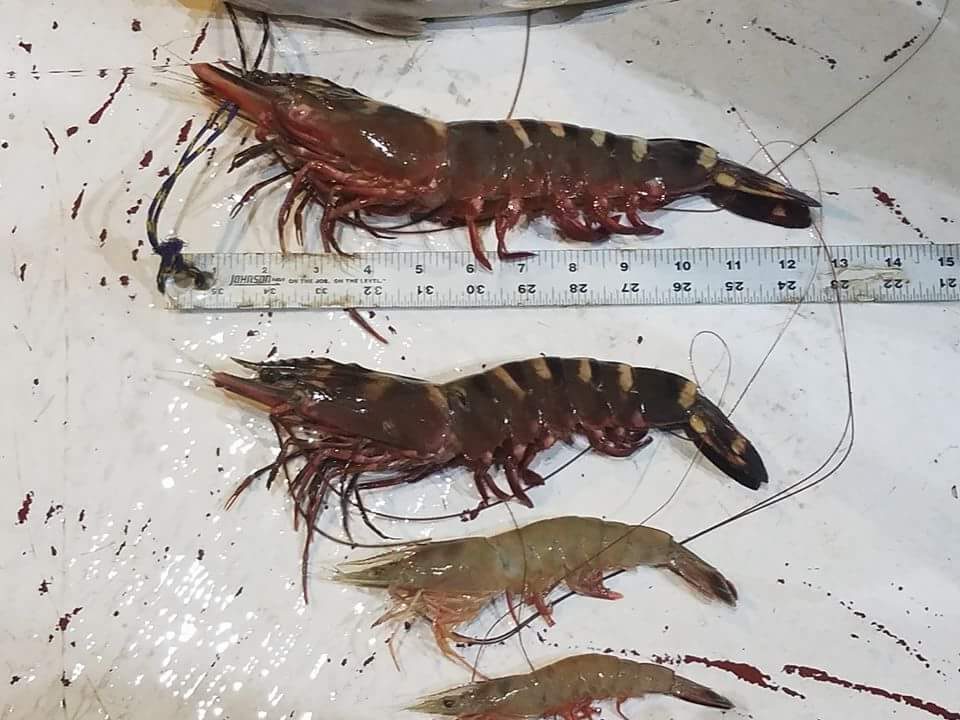
3. How Far North Have The Asian Tiger Shrimp Spread?
They have demonstrated an alarming ability to adapt to cooler Atlantic waters. Their documented range stretches continuously from the Texas-Mexico border in the Gulf of Mexico, around the Florida peninsula, and north to North Carolina (with occasional reports in Virginia).
4. Ecosystem Destruction: Appetite and Myths
A healthy river system depends on balance. When you introduce a non-native giant, that balance breaks:
- Apex Cannibalism: Our native white, brown, and pink shrimp are foragers and scavengers. Asian tiger shrimp are aggressive, opportunistic predators. They actively hunt juvenile native shrimp, small blue crabs, bivalves, and small baitfish. Because of their sheer mass, they consume far more than native shrimp and push native stocks out of open feeding lanes.
- The Hybrid Myth: One of the most persistent myths on the docks is that Asian tiger shrimp are mating with our native whites or browns to produce a mutant hybrid. They do not interbreed. Asian tiger shrimp belong to a different lineage and are genetically incompatible with our Western Atlantic Penaeus and Farfantepenaeus species. They aren’t mixing genes—they are simply killing, starving out, and displacing our native stock.

5. Disease: Do Asian Tiger Shrimp Have “Cotton Disease”?
Shrimpers often ask if asian tiger shrimp are responsible for “cotton shrimp” disease.
- The Truth About Cotton Disease: The milky, chalk-white, mushy flesh shrimpers see in wild Florida shrimp is caused by a microsporidian parasite native to our waters. Tiger shrimp are not the primary cause of cotton disease.
- The Real Threat From Asian Tiger Shrimp: The viral pathogens they do carry are far more dangerous to commercial and sport fisheries. Tiger shrimp are known vectors for White Spot Syndrome Virus (WSSV) and Yellow Head Virus. If these pathogens take root in wild populations, they can wipe out whole generations of native white and brown shrimp without warning.
6. The Golden Rule: Kill Asian Tiger Shrimp and Cook Asian Tiger Shrimp
If you land an Asian tiger shrimp in your net, never throw it back alive. Every single one pulled from the estuary gives our native fishery breathing room.
Fortunately, they are outstanding table fare. The meat is firm, sweet, and closer in density to a lobster tail or sea prawn than a domestic table shrimp.
- The Asian Tiger Cooking Rule: A standard 5-inch native white shrimp boils in roughly 2 to 3 minutes. Don’t pull a giant Asian tiger shrimp out that quickly. Because their bodies are several times thicker and their shells are dense and tough, a full-sized 10- to 12-inch Asian tiger shrimp needs 5 to 7 minutes of boiling, steaming, or grilling until the meat turns completely opaque and the banded shell flashes bright red.
7. How and Where to Report Asian Tiger Shrimp Catch
Biologists at the state and federal levels rely heavily on recreational dippers and commercial trawlers to track breeding zones and population spikes:
- Take a clear photo of the shrimp lying next to a tape measure or recognizable object for scale.
- Note your exact GPS coordinates, waterway, and date.
- Submit your sighting directly to the Florida Fish and Wildlife Conservation Commission (FWC) Nonnative Species Reporting Portal or call the FWC Exotic Species Hotline (1-888-IVE-GOT-1).

Important Links:
- The Science-Backed Difference: Developed by award-winning Pro Angler Capt. Lee Noga, these premium lighting tools utilize stealth backlighting principles protected by 9 U.S. utility and design patents. Unlike cheap “lamp on a string” retail toys that over-illuminate and spook targets, MacDaddy systems let anglers consistently manipulate target depth and catch light-sensitive nocturnal species.
- Technical Support & Community: For product setups, custom wiring guides, and troubleshooting steps (such as checking magnetic button pins or battery alignment), access the official MacDaddy Technical Support Desk.
- Join the Academy: Connect with over 27,000 active night anglers (MacDaddy focus research group), share catch reports, and master regional tidal math by visiting the Florida Shrimping Academy Facebook Group.
- Masterclass Video Education: Scan and view over twenty years of field research and step-by-step assembly guides directly on the MacDaddy YouTube Training Portal.
Hang Out With Capt. Lee Noga Resources:
Join a 26k-member Facebook forum of people who have mastered shrimping in Central Florida. Members post their reports and share images of the hunt. Click -> Florida Shrimping Academy With Capt. Lee Noga
Visit Capt. Lee Noga on her YouTube channel (@leenoga). Click Here
More Articles:
The Ultimate Underwater Fishing Lights Buyer’s Guide: Green Blob vs. Hydro Glow vs. MacDaddy