


By: Capt. Lee Noga. Founder, MacDaddy Fishing Lights
Whether you’re fishing from a dock, a stationary boat, or anchored over a brush pile, understanding how a crappie fishing light works is crucial.
Deploying it correctly can mean the difference between a slow night and a limit.
This guide covers the science, setup, and strategy behind MacDaddy Fishing Lights®, Florida’s most patented and field-tested submersible fishing light system.
Understanding crappie fishing lights can elevate your night fishing experience.
The tech grew out of 11 years of fishing in Florida. This sport involves pursuing highly light-intolerant marine species.
The science proved by Capt. Lee Noga elevated the sport by eliminating guesswork and the learning curve with her skill-building techniques.
Crappie fishing has a lot in common with Florida shrimping.

Understanding crappie’s unique visual mechanics is a game-changer for anglers who want to consistently put fish in the cooler.
Crappie are fundamentally light-intolerant creatures that avoid direct, bright sunlight. However, they become fiercely attracted to artificial light sources once darkness falls. This dual nature dictates their entire daily routine, driving their movement from deep structure to night ambush zones based entirely on lumen delivery and shadow placement.
During the bright midday hours, the crappie’s massive, highly specialized eyes—perfectly adapted for low-light tracking—become a distinct disadvantage. Under a high sun, these fish experience intense discomfort and actively flee the glare.
They retreat deep into dock shadows, heavy weed beds, or submerged brush piles to find relief. On bright days, anglers must fish tight to heavy cover or hunt for deep-water drop-offs where the sun cannot penetrate.
Conversely, overcast skies or rainy days offer a massive advantage. The naturally diffused light coaxes fish out of hiding, making them bolder and more willing to scatter across the flats to hunt. This makes them far bolder and willing to scatter across the flats to hunt.
When the sun goes down, the script flips. Artificial green or white lights become absolute magnets for crappie. The intense glow pulls in clouds of microscopic zooplankton. This draws school after school of hungry baitfish like minnows and shad. Crappie follow the food line but stay stealthy, hovering along the pitch-black outer edge of the light ring.
They use the darkness to ambush disoriented baitfish crossing the line.

Why A Crappie Fishing Light Responds So Strongly to Light at Night
Crappie are sight feeders. Unlike bottom-feeding species that rely on smell or vibration, crappie hunt visually, which makes them exceptionally responsive to a well-placed submersible fishing light.
The food chain triggered by a crappie fishing light works exactly the same way it does for saltwater shrimping. Phytoplankton and microscopic organisms are drawn to the light first, followed by zooplankton.

Small baitfish, minnows, shad, and small bluegill arrive next to feed on the zooplankton. Finally, crappie move in to feed on the baitfish. This food chain cycle is reliable and predictable.
It begins within 15–45 minutes of deploying your crappie fishing light.
Best Crappie Fishing Light Color: Green vs. White

The color of your crappie fishing light directly affects how effectively it builds the food chain in your specific water type.
Green Light for Crappie Fishing Light
Green light (520–570nm wavelength) is the top-performing color for crappie fishing in slightly stained or tannin-influenced freshwater common in Southern reservoirs, oxbow lakes, and backwater systems. Green light scatters less in murky water and remains visible to baitfish and their prey at greater depth than white light in the same conditions. For most crappie fishing scenarios in the Southern United States, green is the strongest single-color choice.
White Light for Crappie Fishing Light
White light is full-spectrum and performs well in clear freshwater. In lakes with high water clarity common in highland reservoirs, natural spring-fed lakes, and deep-water impoundments, white light maintains its penetration depth advantage and provides excellent visual clarity for the angler. If you can see 4+ feet of depth visually from the boat in daylight, white light is a strong option.
Crappie Fishing Light – Dual Green and White: Best of Both
The MacDaddy Smart Light® Series runs both green and white LEDs simultaneously in a single unit. For crappie fishing in variable or changing water conditions, or in lakes where you are not certain of water clarity, dual-mode gives you the strongest possible attraction field. Switching between green, white, and dual color in real time lets you adapt to what is working on any given night.
Crappie Fishing Light Depth: Where to Set It
Depth is the most overlooked variable in the crappie fishing light setup. Crappie hold at different depths depending on the season, water temperature, and structure location. Setting your crappie fishing light at the wrong depth means crappie are present but not entering your light field. You want them to go above the light where they are backlit. This way, you see them, but they do not see you.
Setting your crappie fishing light at the wrong depth means crappie are present but not entering your light field. You want them to go above the crappie fishing light where they are backlit.
This way, you see them, but they do not see you.

General depth guidelines for fishing a crappie fishing light:
Read The MacDaddy Fishing Lights Deployment Teaching Booklet -[Click}
General depth guidelines for fishing a crappie fishing light:
- Spring (spawning season, March–May): Crappie are shallow, 2–4 feet. Set the light at 18–24 inches below the surface.
- Summer (June–August): Crappie suspend deeper over structure, 8–15 feet. Set the light at 4–6 feet below the surface to intercept them on the way up.
- Fall (September–November): Crappie are transitional; follow baitfish. Start at 3–4 feet and adjust based on where you see baitfish in the light field.
- Winter (December–February): Crappie are deep and sluggish, 12–20 feet. A deeper light position (6–8 feet) or a second light near the bottom works best.
The MacDaddy Fishing Lights® patented flotation system holds your crappie fishing light at the exact depth you set, allowing you to make precise adjustments and replicate what works night after night.
Step 1: Choose Your Location to deploy your crappie fishing light.
Crappie are structure-oriented fish. The light does not need to be directly on structure; crappie will travel 20–30 feet to a light if bait is present.
Position your boat or dock light within casting distance of known structure. The light does not need to be directly on structure; crappie will travel 20–30 feet to a light if bait is present.
Step 2: Deploy the Crappie Fishing Light Using MacDaddy Science Correctly

Lower the crappie fishing light slowly; avoid splashing. Set it at the starting depth for your season (see above).
Ensure the light hangs vertically, with the LEDs facing outward. The top of the light should be below the water’s surface; the water above the light must remain completely dark.
This backlights the fish so you can see them clearly without them detecting you at the surface.
Step 3: Anchor or Secure the Light
In moving water (river systems, tidal lakes, reservoirs with current from dam releases), anchor your crappie fishing light with a 5–7 lb weight at the base.

In still water, you can secure the light to a dock cleat or boat rail without an anchor weight. Stability is key; a swinging or drifting light disrupts the bait aggregation and reduces crappie concentration.
Step 4: Wait for the Food Chain to Establish
Allow 20–40 minutes after deployment before beginning to fish seriously. Watch the light field; you’ll first see plankton appear as a fine, sparkling cloud.
Then baitfish will arrive in small groups. Using uncontrolled lumens without proven strategy and techniques can be disastrous.
Once baitfish are stacked in the light, crappie will follow within minutes. The moment you see crappie shadows at the edge of the light field, you are ready.
Step 5: Fish the Edge of the Light, Not the Center
Experienced crappie anglers know fish don’t hold in the brightest part of the light field. They hold at the edge, in the transition zone between light and darkness.
Cast small jigs or live minnows to the outer boundary of the light field and retrieve slowly toward the center. This is where the most productive strikes occur.
Crappie Fishing Light – Gear recommendations
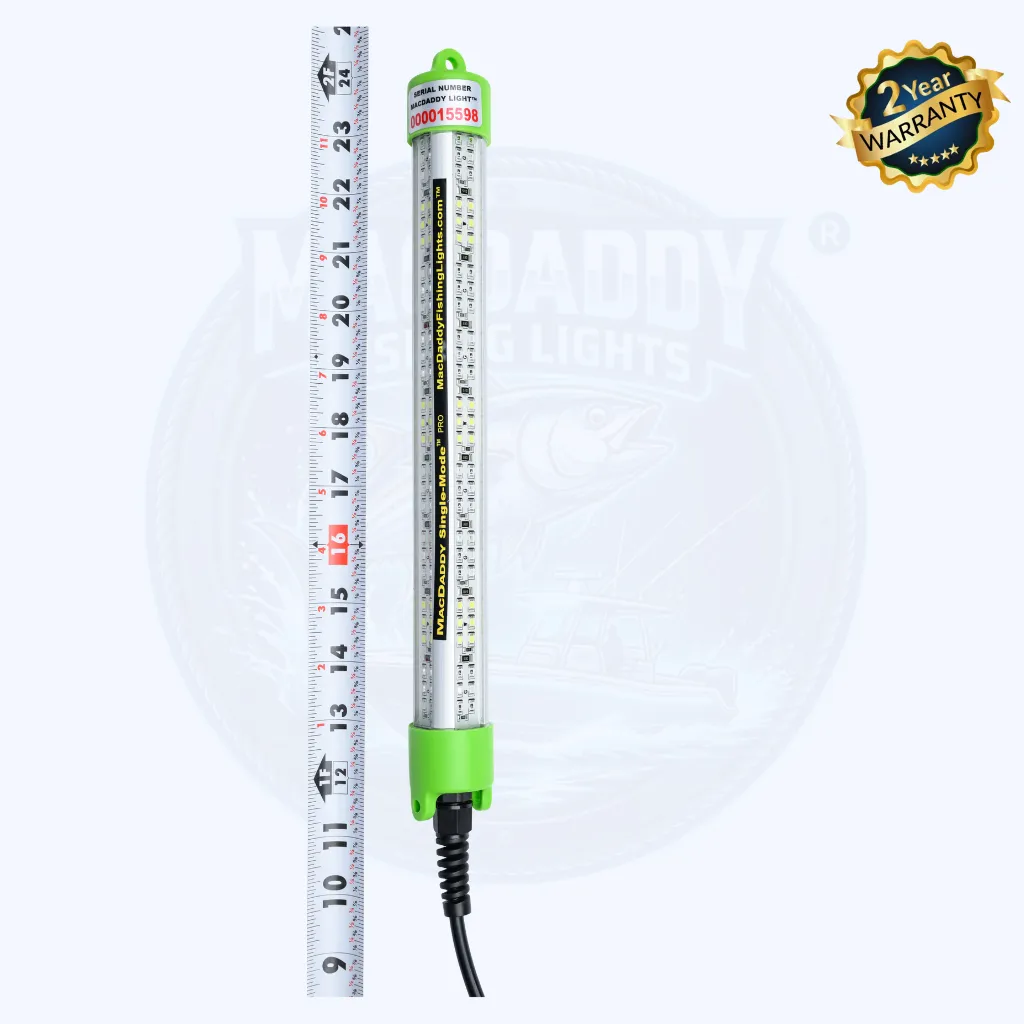
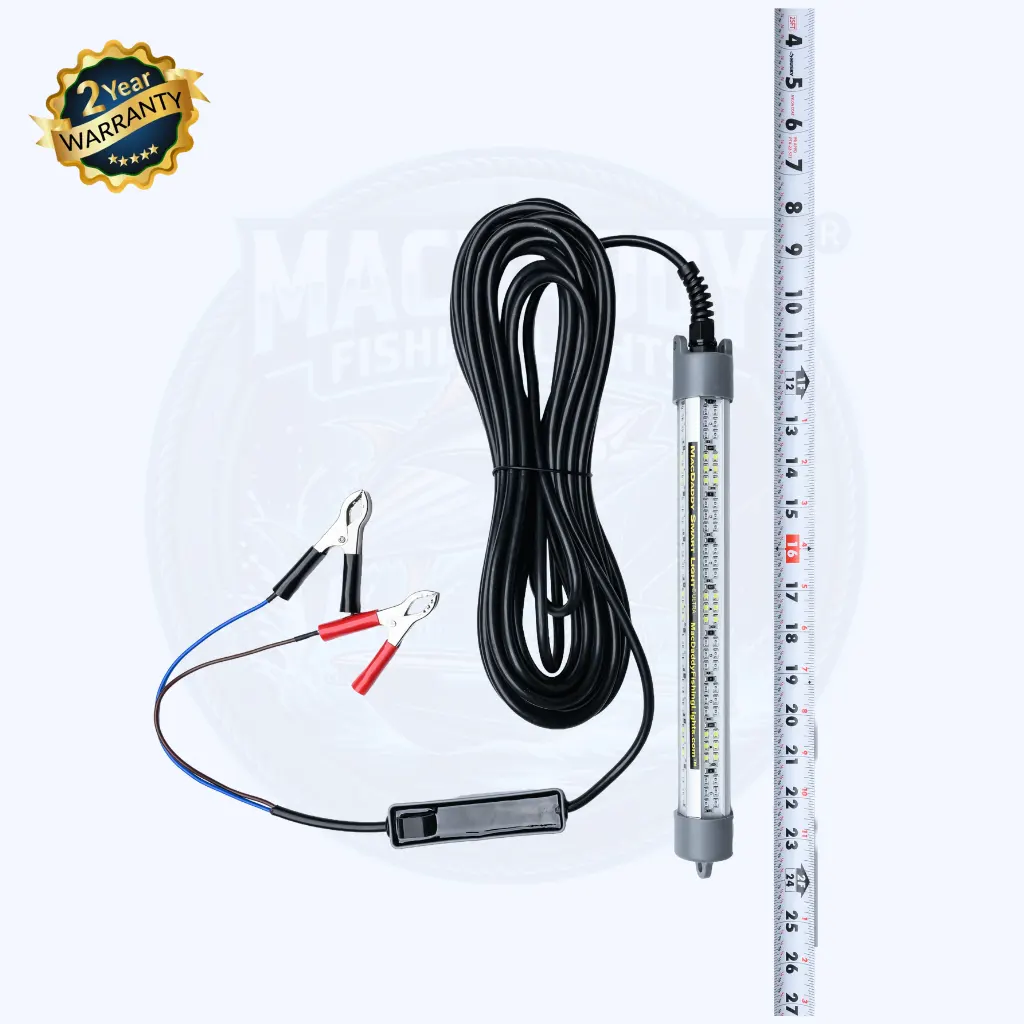
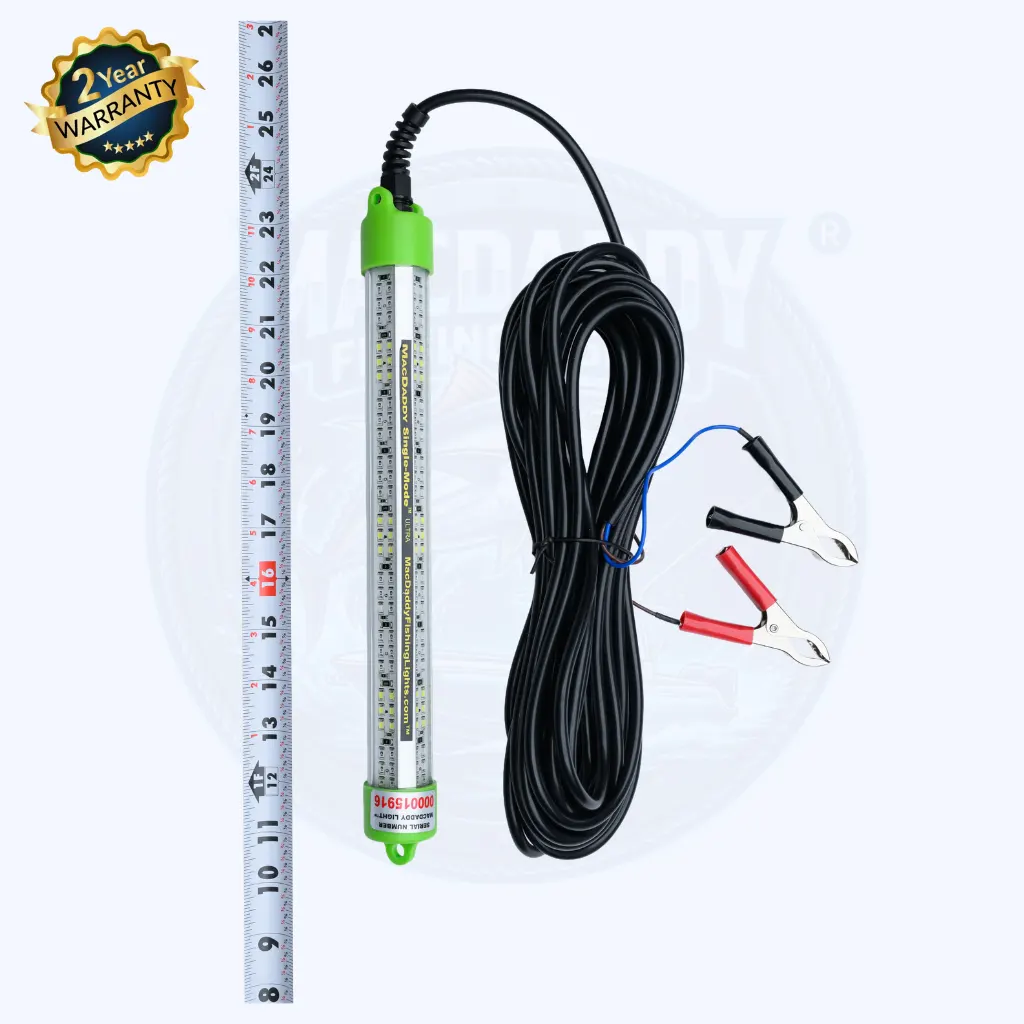
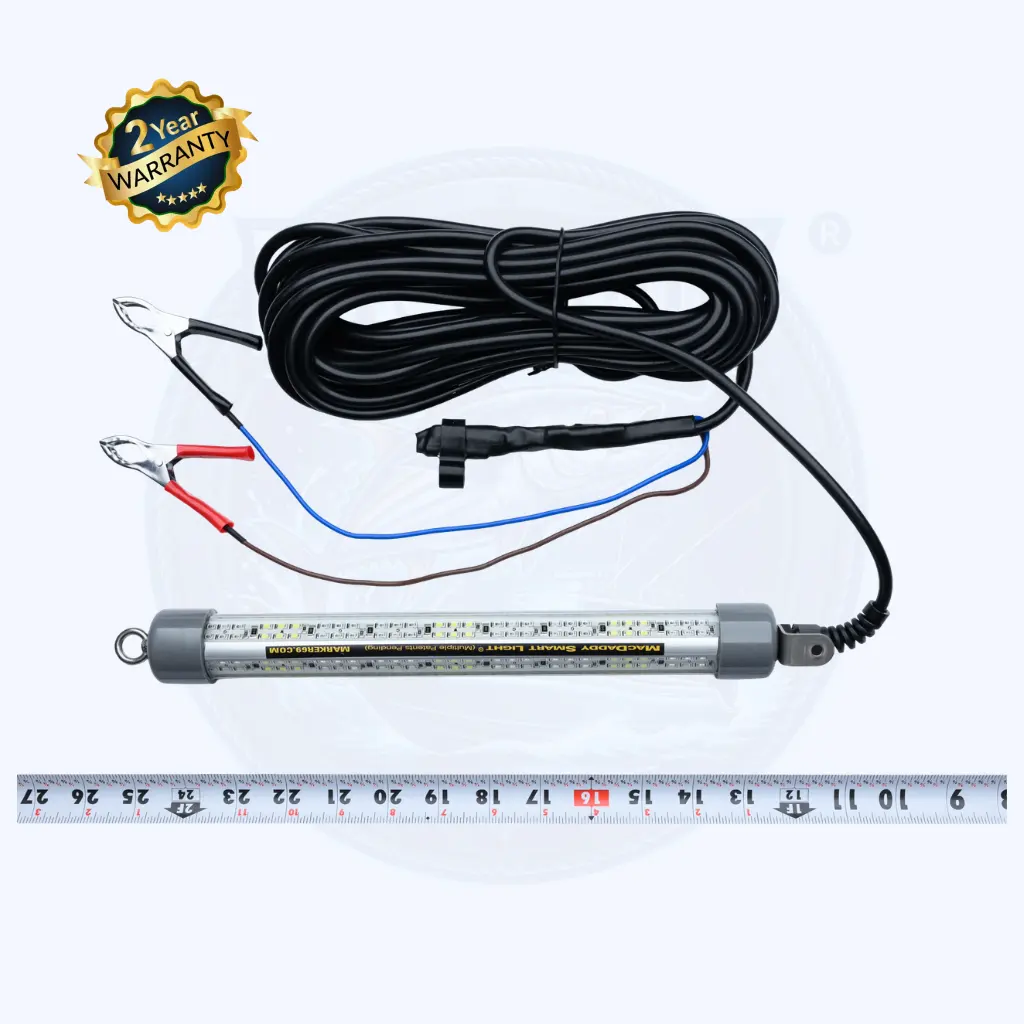
- Crappie fishing light: MacDaddy Single Mode Light™ or Smart Light PRO®, both with green or dual-mode LEDs
- Rod: 5–7 foot ultralight spinning or crappie-specific rod
- Line: 6–8 lb monofilament or 4–6 lb fluorocarbon
- Jigs: 1/32 to 1/16 oz tube jigs or curly tail grubs in chartreuse, white, or pink
- Live bait: Small minnows (1.5–2.5 inches) are devastating near a well-established light
- Headlamp: For rigging and net use, keep it off the water to avoid disturbing the light field
- 12V battery: 675-crank-amp minimum for a single MacDaddy crappie fishing light
Crappie Fishing Light: Common Problems and Fixes
Problem: Baitfish crowd the light, but no crappie appear
This usually means crappie are present but holding too deep. Lower the light by 2–3 feet and wait 15 minutes.
If crappie are suspended at 12+ feet, you may need a second light positioned deeper while keeping the first at a shallower depth to create a vertical light column. Herding targets using light frequency is what turned shrimping into a must-do sport.
With 2 lights, you can get deep targets off the bottom and into stealth mode above the first light, closest to the surface.
The first light is set by a MacDaddy formula, but this article isn’t the only place to learn all about this
Visit the blog page to learn about fishing with proven science.
Problem: Light has been out for an hour, and nothing has appeared
Check your location. Crappie are structure-oriented; if there is no submerged structure within 30 feet, they will not hold in the area regardless of light quality. Reposition to within casting distance of known structure, brush piles, or dock pilings
We recommend always using a scouting light anchor to test the debris structure around where you want to set your light or lights. A simple, cheap rope and a handweight will do the job unless you want to pour more rounded, smaller weights, sinking a U-bolt into your plastic bowl concrete mold. You dont want to deploy a light blindly on a debris bottom without knowing where the snag spots are.
Problem: Bait blackout: dense baitfish block all visibility
If you are using the MacDaddy Smart Lights®, activate the frequency strobe for 45–60 seconds.

This breaks up the bait pod and restores your crappie fishing window.
Single-mode lights can’t solve this; consider upgrading to a smart multi-mode system if bait blackout is a recurring problem on your home lake.
Problem: Light has been out for an hour, and nothing has appeared
Check your location.
Crappie are structure-oriented; if there is no submerged structure within 30 feet, they will not hold in the area regardless of light quality.
Reposition to within casting distance of known structure, brush piles, or dock pilings.
We recommend always using a scouting light anchor to test the debris structure around where you want to set your light or lights.
A simple, cheap rope and a handweight will do the job unless you want to pour more rounded, smaller weights, sinking a U-bolt into your plastic bowl concrete mold.
You don’t want to deploy a light blindly on a debris bottom without knowing where the snag spots are.
Crappie fishing lights on the market are often basic tube lights or fixed LED strips. They lack depth control, anchor systems, and mode options. The MacDaddy Fishing Lights® system was engineered with 9 U.S. patents protecting features unavailable in any other light. This includes the depth-control flotation system, tidal anchor attachment, and patented frequency strobe that breaks bait blackouts. These are not just marketing claims; they are patented, field-tested innovations developed over 15+ years of research.
For crappie anglers, the MacDaddy Smart Light® ULTRA (3000-6000 lumens) is the ultimate setup: dual green-and-white LEDs, 8 programmable modes, depth-control flotation, and a strobe for bait blackout recovery. Backlighting targets in stealth mode require just 3000-6000 lumens. Battery conservation was a bonus, too. Lee Noga’s research.
For optimal results, remember that crappie fishing light strategies can vary based on your specific fishing conditions.
Everything you need for a productive crappie night fishing operation is in a single unit.
For crappie anglers, the MacDaddy Smart Light® ULTRA is the ultimate setup. It features dual green-and-white LEDs, 8 programmable modes, depth-control flotation, and the strobe for bait blackout recovery.
This is everything you need for a productive crappie night fishing operation from a single unit.
Important Links & Declarations:
PATENTS Awarded: MacDaddy Fishing Lights® is protected by U.S. Utility Patent 11,147,263 and 8 U.S. design patents. Innovated by Capt. Lee Noga
- The Science-Backed Difference: Developed by award-winning Pro Angler Capt. Lee Noga, these premium lighting tools utilize stealth backlighting principles protected by U.S. utility and design patents. Unlike cheap “lamp on a string” retail toys that over-illuminate and spook targets, MacDaddy systems let anglers consistently manipulate target depth and catch light-sensitive nocturnal species.
- Technical Support & Community: For product setups, custom wiring guides, and troubleshooting steps (such as checking magnetic button pins or battery alignment), access the official MacDaddy Technical Support Desk.
- Join the Academy: Connect with over 27,000 active night anglers (MacDaddy focus research group), share catch reports, and master regional tidal math by visiting the Florida Shrimping Academy Facebook Group.
- Masterclass Video Education: Scan and view over twenty years of field research and step-by-step assembly guides directly on the MacDaddy YouTube Training Portal.
- Manufacturing Disclaimer: Products evolve continuously over time based on live field telemetry. Finished items may vary slightly from early website or catalog image assets.
- Environmental & Sourcing Notice: Engineered proudly in the USA; assembled utilizing global components. Please remember to recycle responsibly and support green coastal ecosystem guidelines.
→ Shop MacDaddy FIshing Lights For Crappie
→ Read: Green vs. White Fishing Light — Which Color Wins?
→ Join 27,000+ Anglers in the Florida Shrimping Academy