

Click any card to enlarge
What is a smart fishing light?
A smart fishing light is a submersible, chip-controlled LED light that is deployed bottom-up: anchored near the bottom and floated vertical, so it projects a five-foot-thick circle of light sideways through the water — with no light above the lamp. That dark zone above the light is called stealth mode. Fish and shrimp gather in the unlit water where they feel safe, backlit by the glow below, while you watch everything from above.
Most of the fishing-light industry works top-down: a bright lamp hung from the surface, pushing light (and fish) down and away. MacDaddy Fishing Lights® is built on the opposite idea, proven across a decade of research by Captain Lee Noga: the light is the tool, and the method is the advantage. Below, Captain Lee answers the 56 questions anglers actually ask — in her own words, with audio in English and Spanish.
Stealth Mode
What is stealth mode?
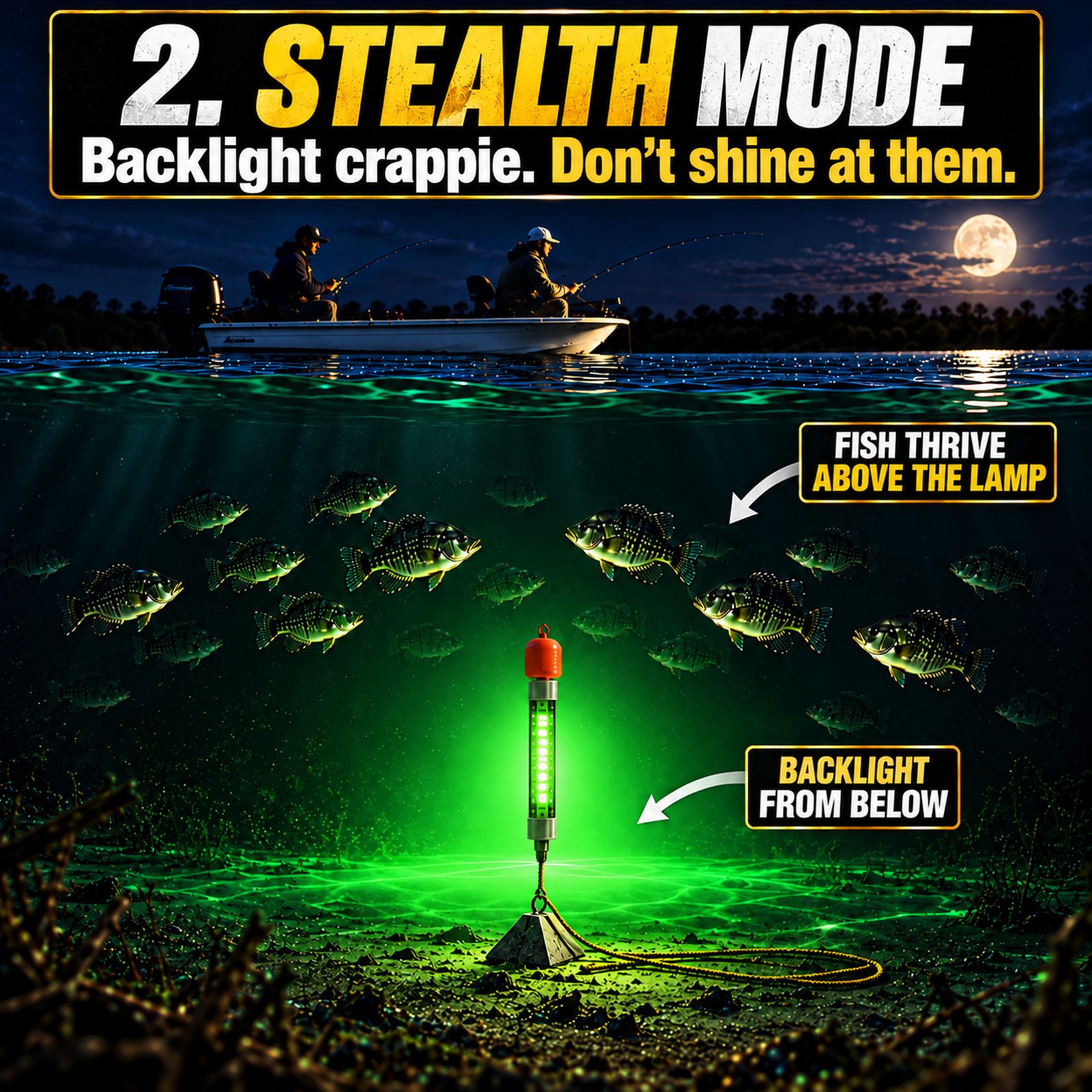
Stealth mode is achieved by deploying a light on an anchor secured to the bottom of the water, producing bottom-up lighting. The light emits a five-foot pancake of illumination, and fish move above it because the water above the light remains unlit.
How does stealth mode work?
When you look down from a boat or a pier, the water appears green. That colour is the light rising from below the fish and backlighting them. The fish are thriving in unlit water above the light while you observe all of their activity, which creates the impression that the water itself is illuminated. It is not.
Why does the water above the light stay unlit?
The science proven by Captain Lee Noga is designed to backlight the target while preserving the ecosystem, rather than disrupting it with reckless lighting. The water above the light remains unlit because no bulb points toward the surface. The light projects sideways, forming a circle of illumination five feet thick, with no light above the anchored lamp. That unlit zone is the thriving ecosystem known as stealth mode, and it remains unlit because the light emits in a circle and does not shine toward the top of the water.
Why is unlit water above the light so important?
Unlit water is important because disrupting the ecosystem is, in Captain Lee Noga's view, inhumane. It is not normal to project intense illumination into a nighttime environment. Marine life thrives at night because it is dark, so the manner in which illumination is presented should be humane. The objective is to avoid disrupting and scattering the fish and shrimp.
How does stealth mode backlight the fish and shrimp?
Stealth mode uses bottom-up lighting, with the light anchored to the bottom. The depth is set according to the depth-minus-eight formula. For example, in 12 feet of water, 12 minus 8 equals 4. You touch the weight, count four feet up the rope, and clip it with the long-line clip attached to the bottom of the lamp. This ensures the correct amount of unlit water above the light, allowing the ecosystem to gather above it and continue its natural activity.
What happens when you use bright light instead of stealth mode?
Any illumination will upset light-sensitive species, causing them to scatter because they cannot process that level of light. When you present an unilluminated portion of their ecosystem, they thrive. The question is therefore one of humane treatment. There is no reason to disrupt them with 15,000 lumens, which will not improve your catch. In stealth mode, the fish and shrimp have unlit water and are not subjected to unnecessary stress. As a hunter, you should be humane.
Why do fish scatter and avoid a bright light?
Fish scatter because bright light exceeds their tolerance. This is why it is essential to understand the ecosystem, rather than assuming it is acceptable to overwhelm it with an inhumane amount of illumination. Consider removing the lampshade from a lamp, standing approximately 12 inches away, and staring directly at the bulb for an hour. That is the experience you are imposing on them.
Is stealth mode the same as turning the light down low?
No. Even at a low setting, illumination is still illumination. Stealth mode has zero illumination above the light. There is no light above the buoy or the top of the lamp, which is held in a vertical position and anchored to the bottom. The absence of light above the lamp is what defines stealth mode.
Can you see the fish without a camera or sonar in stealth mode?
Yes. In real time, you can observe how the ecosystem interacts with a wide variety of marine life, something that was previously available only through a submerged camera. You are fishing this in real time. That is one of the most significant changes in night fishing to result from the research of Captain Lee Noga.
Does stealth mode work in freshwater and saltwater?
Yes. Although all of the research was conducted in shrimping, because shrimp are extremely sensitive to light, the method is not restricted to shrimping. It can catch anything in a marine ecosystem, whether in freshwater, saltwater, or ice water. It creates stealth mode and brings the ecosystem above the illumination, where it thrives. That keeps the fish and shrimp calm. You see them, they do not see you, and you are positioned for the strike.
Does stealth mode work for shrimping and for fishing?
Yes. MacDaddy Fishing Lights are designed for every species you can catch during the same hunt. The rest of the fishing-light industry serves light-tolerant species well but does not perform well for light-intolerant species. We recommend learning which species are light-tolerant and which are not. It made sense to build one light that could serve both types during the same outing. That is the MacDaddy Fishing Lights product line: whether you choose the Smart Light or the Single Mode, both deliver the process.
How do I know I am in stealth mode when I deploy the light?
You will know you are in stealth mode because you will see marine life in your light field, calmly working the upper water for their food supply. There is no urgency and no nervousness. You are seeing a true reflection of the ecosystem, with all of the activity taking place above your light in unlit water. If you see nothing in your light field, there is a problem: your light is probably too high in the water column, which eliminates the unlit water. The deeper you sink the light, while still being able to see from your boat or from a structure, the more unlit water there will be above it. Always sink it as low as you can while retaining the ability to identify targets. In tidal water, sink it as deep as possible, because you will lose the first one or two feet of water over the outgoing tide, and a light with no unlit water above it will produce no activity.
What is the difference between a MacDaddy light in stealth mode and a regular bright light?
The difference is control over your illumination. We use light to create stealth mode above the lamp. When fish and shrimp encounter our ring of light beneath the water, they choose to move above it, where they settle in and thrive. A regular bright light offers no control over depth or location. It can sway, drift, and project lumens indiscriminately, placing enough stress on the ecosystem to disperse it. That is cause and effect.
Why did you invent stealth mode?
I invented stealth mode because I was unable to catch light-intolerant shrimp successfully. I needed a way to use illumination without disrupting the ecosystem. When I found that balance, I realised it was an extraordinary discovery. With this short, easily remembered technique, you gain the greatest advantage in night fishing, an advantage that reckless illumination has undermined for decades. This is the only way to fish while maintaining an ecosystem that is thriving rather than spooked.
Lumens and Light Science
How many lumens do I actually need to catch fish at night?
Scientific research shows that as little as 1,500 lumens is sufficient, and that you should not exceed 6,000 to 7,500 lumens. That is the acceptable upper range, provided you have created stealth mode. Water clarity also determines whether you should use the upper or lower end of that range: in crystal-clear water, you should remain toward the lower end. The MacDaddy Smart Light allows you to reduce power. The Smart Light PRO provides 1,500 to 3,000 lumens, and the Smart Light ULTRA provides 3,000 to 6,000 lumens.
Why is 1,500 to 6,000 lumens enough?
Because you are backlighting the shrimp, and backlighting allows you to see them. The question is how much light is required to backlight the targets so that you can identify them. The studies showed that 1,500 to 6,000 lumens is sufficient.
Why is more light not better?
Uncontrolled light is far more damaging today than it was five years ago, when lights produced fewer lumens. The objective is to backlight your targets without disrupting them, which is why MacDaddy Fishing Lights developed stealth mode. In doing so, you protect and preserve the environment while backlighting the fish and shrimp so clearly that you can see every detail. That is the advantage for both the angler and the ecosystem. Anything short of stealth mode is harmful to the ecosystem.
How does light affect marine life at night?
Illumination creates a nighttime food chain, and this is how plankton draws fish. The light attracts tiny organisms such as plankton, which gather nearby. That draws in bait fish, because small fish feed on plankton. When the bait fish arrive, predator fish follow, and crappie will follow the bait fish. That is a case in which light genuinely begins by attracting plankton. In tidal water, however, whatever you attract will be carried approximately half a mile away within about five minutes, because plankton is flowing through tidal water at all times.
Why do fish and shrimp thrive at night because it is dark?
In many cases, marine life is light-intolerant. Some predators prefer to hunt at night because they feel they have more cover. There are many reasons, but the marine ecosystem never ceases to exist. It does not go to bed and wake up in the morning. The ecosystem thrives 24 hours a day, seven days a week.
Does bright light disrupt the ecosystem?
Yes. Reckless lighting disrupts and disperses the ecosystem, leaving the area in which you are fishing devoid of marine life.
What is the difference between light intensity and light placement?
Light intensity is a measure of how bright the light is, including whether the LEDs are directional. Light placement is the position of the light in the water column, in other words, the physical placement of the lamp itself. Light intensity is therefore the measure of the illumination produced by the light you have anchored.
How does MacDaddy light use light as an advantage and not just illumination?
We use illumination to backlight the targets. Because we backlight them, we can see them while they remain in the unilluminated water above our light. Our light is 12 inches long and emits a circle approximately five feet thick, positioned low in the water column, so all of the water above that light is dark. You encounter a five-foot pancake of light, which is our lamp, and below it the water is dark down to the bottom, where the anchor rests. We use light to backlight the fish and shrimp, but not at the cost of destruction, scattering, and panic caused by illumination. We use a controlled amount of illumination, approximately five feet thick and radiating about 18 feet. We give marine life a place to go above the light, where the greatest amount of unlit water is located. That is why they do not go below it: according to our depth-setting formula, there is very little space below the light field.
What colors of light does MacDaddy use and why?
We use two LED colours: white and green. They are the two best choices for wavelength penetration, superior to blue, amber, or red. We provide a higher power of green and a lower power of white. Captain Lee Noga's research found that adding the white strip at a lower power allows us to see deeper into the stealth mode we have established, so we can identify more targets at greater depth. The two colours are not equal in lumens: the green LEDs are higher in lumens than the white. What you see, therefore, is a beautiful, soft green glow in the water. Remember, however, that this glow is set according to a formula, with five to six feet of unlit water above it.
How long did you study light science before you built the light?
I began studying the science in 2010, drafted the first MacDaddy product on paper in 2015, and brought it to market in 2016. The 2016 Smart Light, now known as the Smart Light PRO, has been a flagship product for 10 years, and anglers still prefer it in very clear water. The Single Mode, also known as the Single Mode intensity light, is simply on or off, with no other modes. It uses the same science and the same deployment techniques as a Smart Light. All of our products are designed to create stealth mode. The difference between the two lights is their features.
When did you discover that the industry belief about light intensity was backwards?
I discovered that the industry belief about light intensity was backwards when I failed dramatically for an entire season of shrimping. No matter what I did, I could not succeed. I spoke with ten other boaters near me, and they all had different levels of success. I could not understand why there was so much variation in how well people did. I realised that the one common factor, the one thing we could not control, was how we all set our lights. Everyone does it differently, and most people simply allow the light to settle wherever it goes and then hope to find shrimp. That explained why ten different people near me achieved ten different results. It came down to how we set our lights. At that point, I knew that illumination was the key to correcting the market and advancing the sport.
What does "the method came first, the light followed" mean?
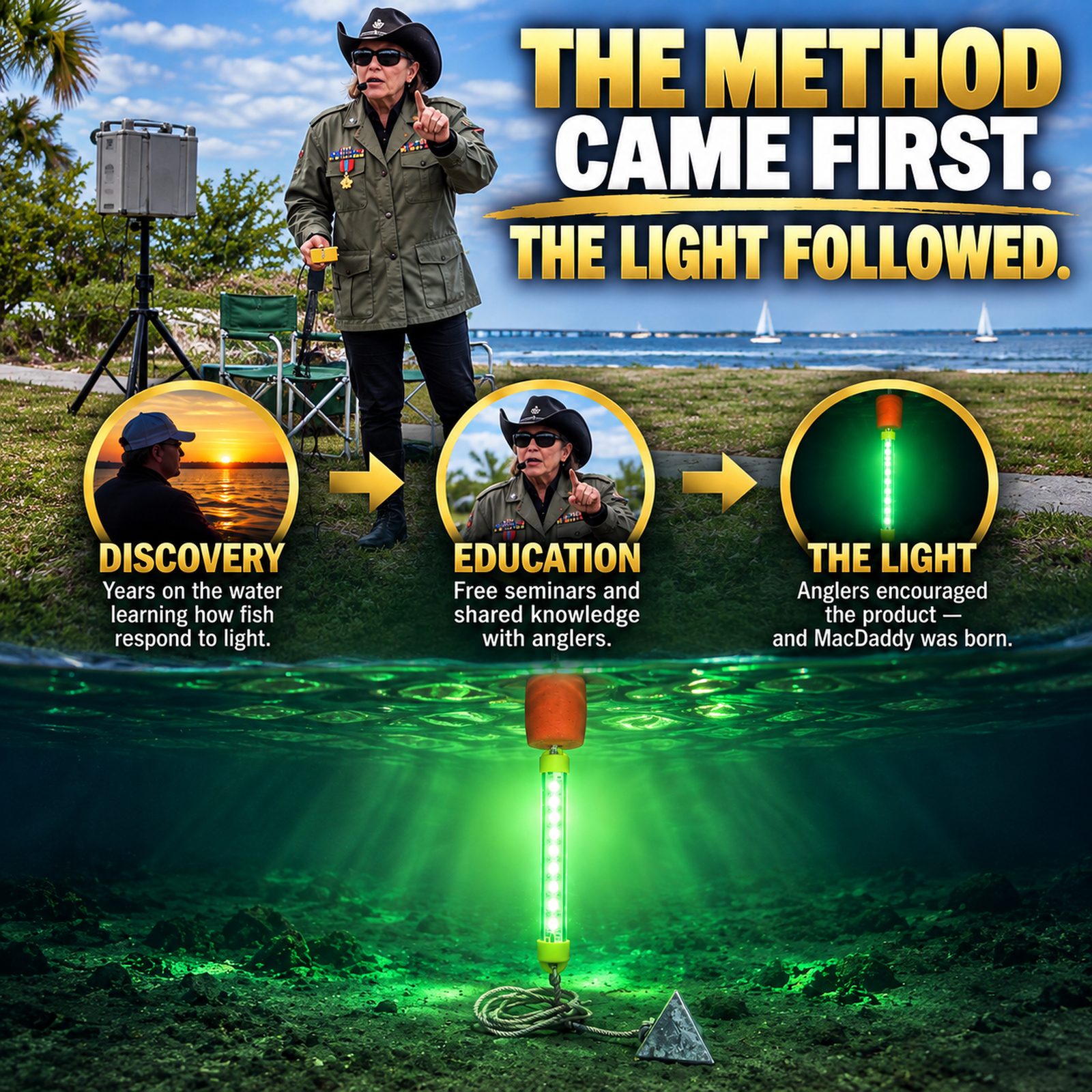
My focus was that of an angler frustrated by spending $60 on an outing to catch shrimp and failing repeatedly for a couple of seasons. I concluded that there had to be a method. I began around 2004, and in 2010 I had my first breakthrough. With LEDs, we were able to shorten the tube, and because it was so much lighter, we could make it buoyant and hold it vertical. That changed everything. After I established the fundamentals, I began teaching people how to create stealth mode, and it was not until 2016 that we released the first MacDaddy products. My teaching therefore came years before the products. Consumers asked me to build the perfect light because they respected my work and my scientific discoveries.
How is MacDaddy different from a dumb light?
First, a dumb light is defined as a light without a computer chip. A Single Mode is an on-and-off light. A Single Mode is dumb in the sense that it has no computer chip, but that does not mean it cannot deliver the process. It provides illumination that you can control through the process. The terminology people confuse is dumb versus smart, and that is the difference between a light with a computer chip and a light without one.
Setup and Deployment
What is in the box with the MacDaddy light?
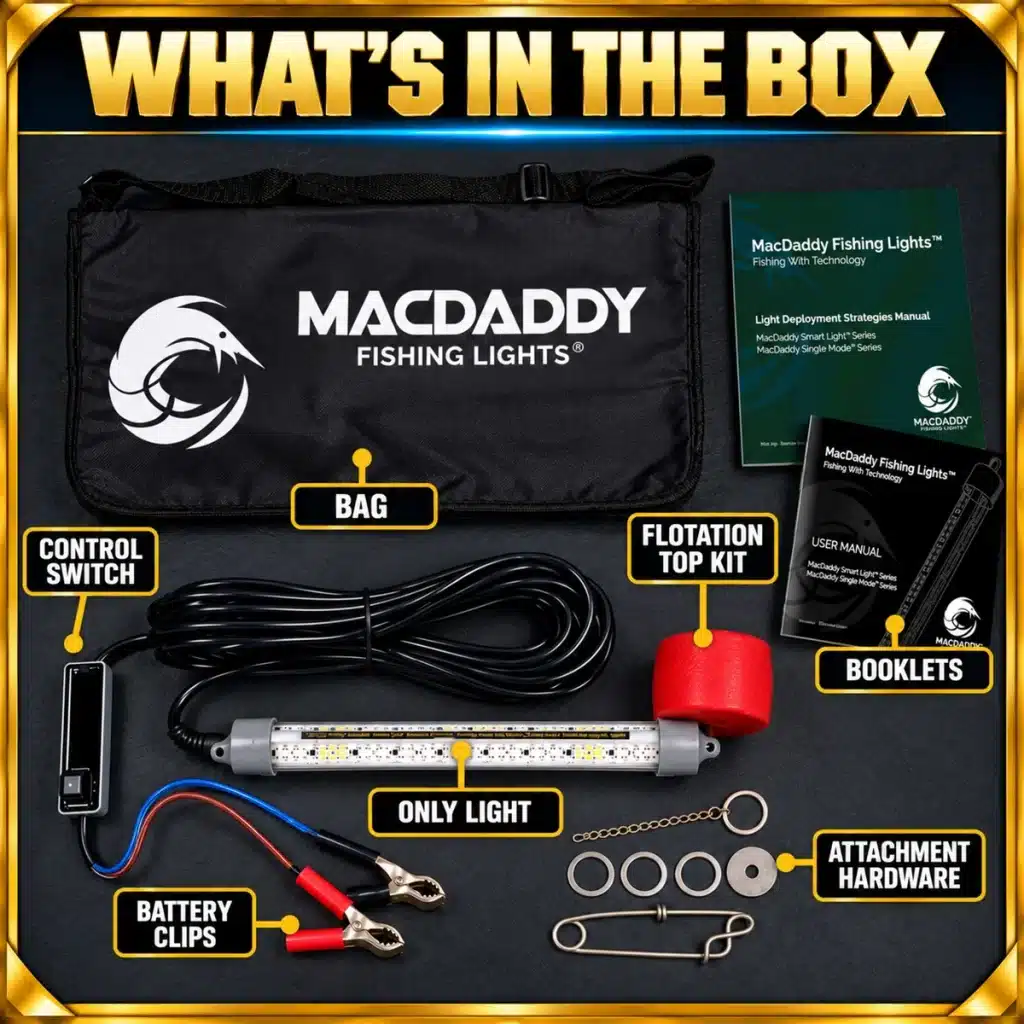
Every model includes the lamp, three split rings, a custom chain for the flotation kit, a long-line clip, and the user and teaching manuals. You therefore receive all of the flotation accessories, the long-line clip, and the split rings that attach to the bottom of the light, where the anchor rope is tied.
What do I need to supply to deploy the light?
You must supply 20 feet of rope, either sinking rope or leaded crab pot line, and a weight of seven to eight pounds at most, whether a hand weight or a custom-made concrete weight. You also need a 12-volt battery with at least 675 cranking amps. If you are running several Ultras, you may prefer a marine-sized battery. The anchor and the leaded crab pot line are not included, although we are working on including the line. I cannot yet say when that change will reach everyone.
How do I anchor the light?
Attach the rope to a split ring at the bottom of the light, using a weight of at least seven to eight pounds. Count up from the weight and clip the rope at the calculated point. That is the ideal position for the depth in which you are fishing. In tidal water, make two additional deployments, raising the clip up the rope each time so that the light sinks six inches deeper on the second deployment and again on the third. This is necessary because you will lose one to two feet of water during the outgoing tide.
What is the formula depth minus eight?
Take the depth of the water in which you are anchored and always subtract eight. The result is your variable. For example, in 12 feet of water, 12 minus 8 equals 4. Touch the weight, count four feet up the rope, and clip it there. Repeat this process until the light is as deep as you can place it while still maintaining visibility.
Why must the light float vertical?
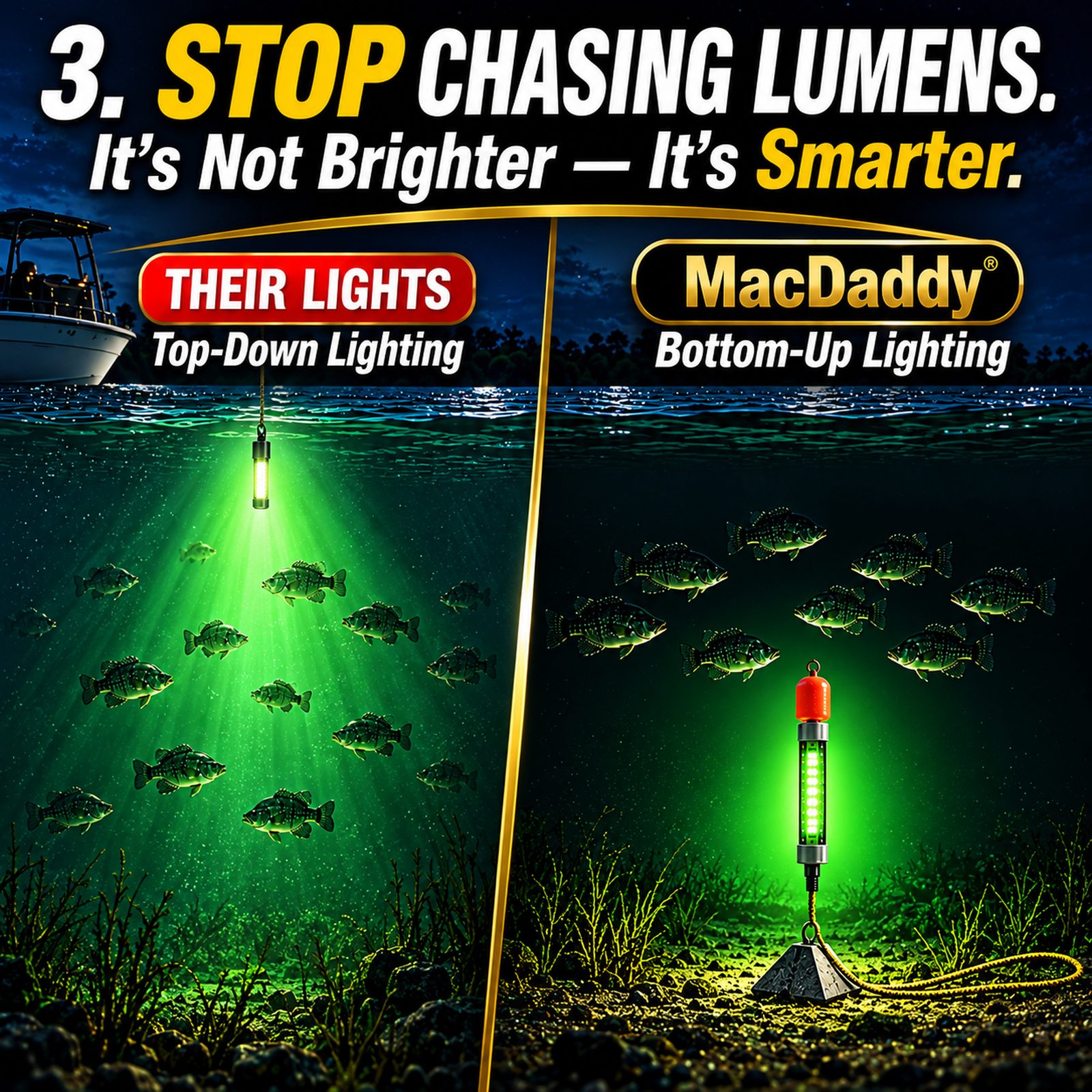
MacDaddy Fishing Lights uses bottom-up lighting, whereas 99 percent of the rest of the fishing-light industry uses top-down lighting. I want to protect the upper water column in stealth mode. The other 99.9 percent of the industry illuminates the top of the water column, and the light grows darker as it approaches the bottom. We are therefore a bottom-up company, and they are top-down. The problem with top-down lighting is that it drives fish under your boat. With bottom-up lighting, you create stealth mode, bringing the ecosystem into the upper part of the water column, where you can see it and where the fish can see your hook, line, and bait and strike.
How deep should the vertical light be?
As deep as possible, while you can still identify objects in your light field, such as grass, a bait fish, a twig, a cigarette butt, or a leaf. If you are not in tidal water, that is exactly how you determine your depth. In tidal water, you must go as deep as you can, to the point where you can barely see, because over the next six hours your light will appear brighter as the water level falls with the outgoing tide. In freshwater, you will know immediately that you have the correct depth. The lower the light is in the water column, the more stealth mode you have above it. Remember that principle: the lower the light, the more stealth mode above it, and the more stealth mode above it, the greater the ecosystem. The amount of activity will therefore be relative to the depth of your light.
What is the flotation top kit for, and why do I need it?
The flotation kit keeps the light vertical so that it can emit a 360-degree circle of light five feet thick. It allows the light to remain vertical in moving water. This is a light for saltwater and freshwater, wherever you choose to fish, and one light should serve you for every type of fishing.
How do I keep the top of the light up?
Use the flotation kit that MacDaddy provides in the retail packaging.
What kind of rope do I need, and why sinking rope?
Ideally, you want rope with a leaded strand, known as crab pot line, at least 5/16 of an inch in width. Any excess rope in your deployment will lie on the bottom. If you buy 75 feet of foam-core rope for approximately nine dollars at a big-box retail store, it will float in the water column, and the targets and bait will strike it, creating nervousness in the ecosystem. With sinking rope, or sinking pot line with a leaded strand, the excess lies on the bottom of the river or pond and does not float in the water column.
What kind of battery do I need?
If you are using a light of 1,500 to 3,000 lumens, you can run two lights on a tractor battery with 675 cranking amps. If you are deploying two Ultras and need to remain out for more than six hours, you may need a full-sized car battery. Never use your accessory batteries or your trolling-motor batteries to power your lights. A 24-volt or 36-volt trolling motor will burn out your 12-volt light.
How long is the MacDaddy fishing light cord, and how do I set it up?
The cord is 33 feet long, by design. The fishing-equipment market has promoted 50-foot cords, but the longer the cord, the more lumens you lose. That is why we settled on 33 feet. The cord is built into the light and comes with alligator battery clips as standard. You are welcome to replace the clips, but you must solder them competently. If your light fails because of the way you fitted the clips and you shorted out the light, it will not be covered under warranty.
Can I use the light from a dock, a boat, or a pier?
Yes. Before deploying the light, always test the area with a decoy anchor, which is simply a rope and a weight tied to a cleat on your boat. Lower the dummy weight, and if it snags, you will know that is not a suitable place to deploy your light. In the worst case, you will lose only the dummy weight. Make multiple test deployments with the dummy weight to explore the bottom and determine whether it is a snag-prone environment before you set down the real anchor and light.
Is there anything I can do to protect my light if it snags on the bottom?
Yes. Place a breakable cable tie between the weight and the rope. If you snag and the anchor will not come free, simply break the cable tie. You will recover your light and lose only the anchor.
Shrimping Technique
How do I shrimp with a MacDaddy light?
Be mindful of when you go, and consider the moon cycle. Fish only on building tides, or immediately after a major moon event. Deploy your light using the formula, and in tidal water deploy it several times until it is as deep as possible, knowing that you will lose one to two feet of water during the outgoing tide.
How do I know when the shrimp are coming to the light?
Once you have established stealth mode with the depth-minus-eight formula, you have created a substantial amount of unlit water above the light. The light below emits a five-foot-thick, 18-foot circle. When shrimp reach the boundaries of that circle, they will choose to move above it, into the stealth mode above your light. You will see them approaching, and that is the time to begin dipping.
How long does it take for shrimp to come to the light?
Shrimp are not coming to your light. We do not want them to react to the light, because they will become nervous, dive deep, and go under your boat. We want them to move above our light, which places them in stealth mode, where we backlight the targets above. As soon as it becomes dark, as soon as the sun has set by 90 percent, they begin to rise and come out.
What is the best time of night to shrimp?
The best time to shrimp is when you have the most hours of outgoing tide. An outgoing tide lasts six hours, and the time available to you depends on when the tide changes. Consider your cost and your time: is it worthwhile, and how long do you want to be out? Ideally, shrimp on building moons.
Can I catch fish with the same method I use for shrimp?
Yes. MacDaddy Fishing Lights can catch both light-tolerant and light-intolerant species during the same hunt. We are the only light that can make that claim.
What species can I catch with the MacDaddy method?
You can catch anything. No species is excluded. The most popular catches include redfish, snook, sea trout, tarpon, mangrove snapper, and black drum. It catches crappie and bass, and it will catch all kinds of fish. That is the beauty of MacDaddy: it gives you the full spectrum. No other light manufacturer can say that.
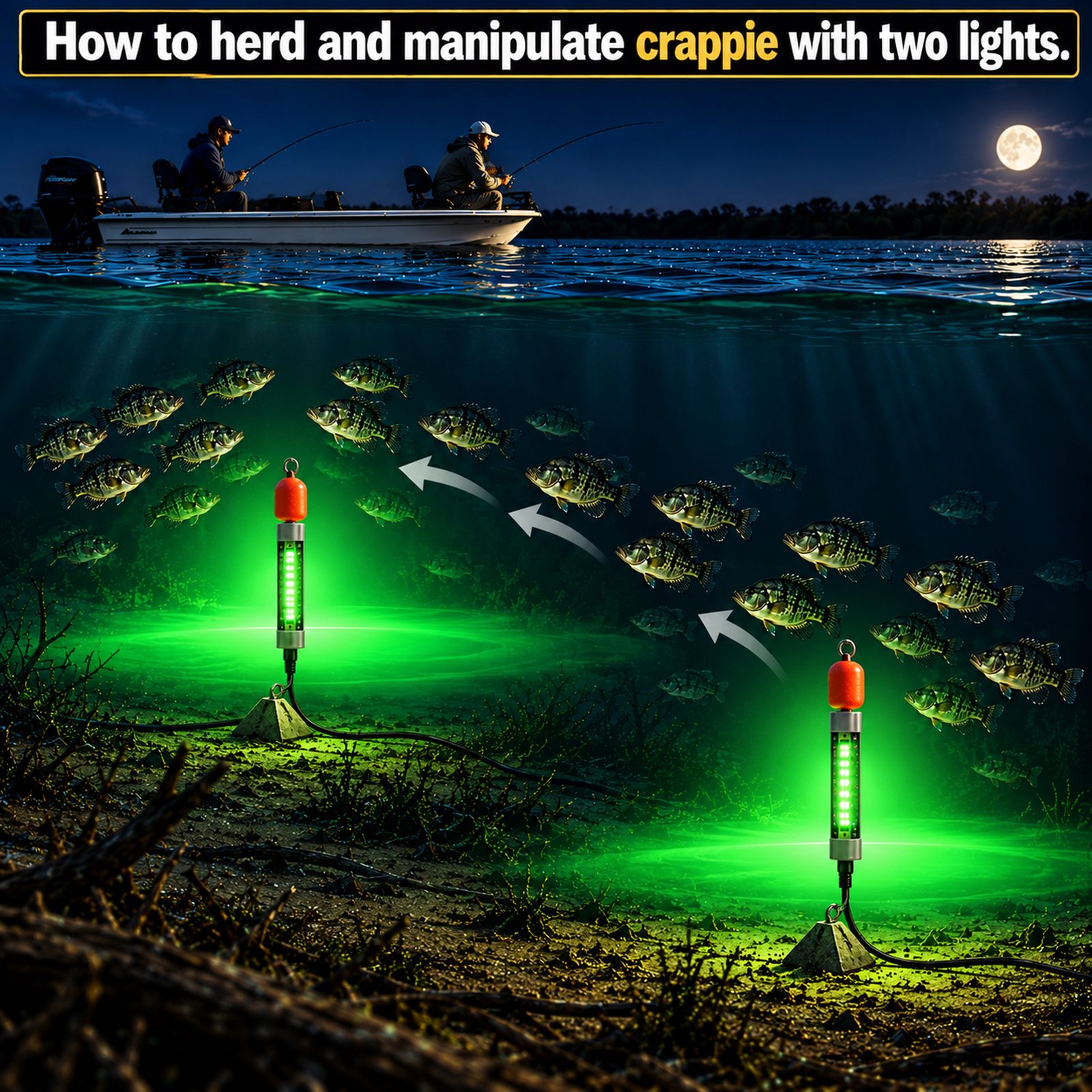
How do I catch crappie with the MacDaddy light?
In the same way you would catch shrimp or any trophy fish. It is one method for all species. This is a light you can take north, south, or to the islands, and you can catch every species native to the location in which you are fishing. No other fishing light can make that claim.
Can I catch bass with the MacDaddy fishing light?
Yes. Our light catches all species, anywhere in the world you want to fish. Stealth mode consistently moves the ecosystem and creates the conditions that precede a strike, anywhere, for any species.
Do I need to be in deep water to use the method?
Your limitations are a 33-foot cord and 20 to 25 feet of rope tied to your anchor. I would not go deeper than 20 feet if you want bottom lighting. However, we hear more and more reports of anglers fishing offshore, deploying the light to its maximum depth, letting it go straight down, and then letting their lines go under the boat and bringing in enormous fish. The verdict is clear: the MacDaddy is favoured offshore and inshore, in shallow and deep water. If you want to fish in water deeper than you can anchor on the bottom, simply add a few ounces of weight to the top and send the light straight down 20 or more feet. The reports are excellent, and anglers are very successful in catching trophy-sized fish.
Why does shallow water not work for the method?
In shallow water, there is no depth of water that we can convert to stealth mode. There is no way to manage the illumination, because the light field we create, which we sent divers to observe, is five feet thick. If you are fishing in five feet of water, there is no unlit water available. That renders any fishing light ineffective. If you are fishing in water that shallow, you may prefer one of the lures that light up.
Can I use the light under a bridge?
Yes. Bridge fishing is excellent, because a volume of water forced between the pylons increases the speed of the current, which snook favour. Anglers do lower our lights with a weight on the end, straight down, so that they have stealth mode above the light and stealth mode below it, because MacDaddy emits a five-foot ring, 18 feet wide. Never deploy a MacDaddy with the anchor in a bottom-up position under a bridge, because bridges are a graveyard of boulders, machine parts, and old bicycles. Instead, lower it over the side, weight the end, and ease it down into the water, creating stealth mode above the light, even though you have deliberately deployed it in reverse.
How do I avoid snagging the light on the bottom?
We teach bottom-up lighting, but in deep water, top-down is the only practical option. Because we understand how our directional LEDs perform, anglers can simply go over the side, add weight to the end of the light, and ease it straight down into the water column to a depth of about 20 to 25 feet. It will create stealth mode above it, in deep water, without the need for an anchor.
What should I do if the fish or shrimp scatter?
You are observing cause and effect. The cause is the illumination, and the effect is that the fish and shrimp are scattering. That means you have overpowered the area, leaving them nowhere to escape, so they disperse in confusion. That means you are not in stealth mode. This is a common failing of 99.9 percent of fishing lights, other than MacDaddy Fishing Lights.
How do I learn the method, if I have never shrimped or night fished before?
Captain Lee Noga has dedicated her life to sharing her discoveries. Her 2026 master class video is available on YouTube at Lee Noga, L-E-E-N-O-G-A. You can also find the same videos in the video and educational sections of MacDaddyFishingLights.com. Captain Lee produced these training videos in both English and Spanish.
What is the difference between a shrimping light and a fishing light?
A shrimping light must be technical, because of the high sensitivity of shrimp to light. Brown and pink shrimp are light-intolerant, while white shrimp, which can tolerate light, are now mixed into the winter run. A shrimping light is therefore a more technical light, designed to catch the most fragile and light-sensitive species in the ecosystem. A fishing light is primarily a source of illumination, and it removes the opportunity to catch light-intolerant species. A shrimping light can catch anything, whether it is light-sensitive or not. A fishing light available on the market is simply a waterproof lamp on a cord, and it is better suited to light-tolerant species. A fishing light can catch species that are not light-sensitive, but it struggles with light-sensitive species, which makes it a poor choice as a shrimping light.
Why is MacDaddy so science-based, and nobody else's that manufactures lights?
Because Captain Lee Noga began as a consumer of fishing lights and spent time trying to understand why they performed as they did. Because she was a captain, she was able to gain an audience and share her science. It then caught fire and went viral in Florida, and anglers asked her to build the perfect fishing light to deliver her science. That is how it became the People's Light: it was a consumer-driven, viral event. To this day, we are reaching people nationally and globally. It is a technique that works, and it is proven. MacDaddy did the work, secured the patents, built the educational programme, and, five years later, built the light. The rest of the industry simply mass-produces waterproof lights with no instructions, and that is the difference. Part of the answer is that they did not do the hard work. They merely replicate what they know they will not be sued for building, and they continue to talk about plankton. That does not help people who want to catch shrimp. We determined why those lamp-on-a-cord lights fail, and we built a light to correct the market.
Ready to fish the method?
Every MacDaddy light is built to create stealth mode. The Smart Light® ULTRA (3,000–6,000 lumens, 8 modes) is the flagship; the Smart Light® PRO (1,500–3,000 lumens) is the original anglers still swear by in very clear water.