

By: Capt. Lee Noga, MacDaddyFishingLights.com
If you have any intel to add/correct, contact me at [email protected]
The Space Coast Shrimping & Fishing Master Playbook
A Local Guide to Titusville Pier, the Railroad Bridge, and Haulover Canal. This map isn’t 100% accurate for the RR Bridge, but it gives you a general idea. We wanted to highlight the landmark, not the map’s accuracy. The map does illustrate the hot spots. This is a generic guideline for discussion, not a historical map.

1. The Biological Secret of North Brevard County
Note: These Haulover Canals have limited spots (15 premium spots & about 50 total for the area). Competition for these spots is severe. Brevard locals rely heavily on these 2 locations. Spots go fast. Boats show up as early as 3 pm to get a spot. Fishing runs from sun down to sun up (12 hours), is wind-driven, and can be spotty, requiring a minimum 8-hr effort. This is not a place to go as a beginner. Learn the ropes in Volusia County (tide-driven) before tackling Brevard. The parking lots are chaotic and have higher crime reported. The swells can be severe for small craft. Bring extra anchors; anchors can easily get snagged. Always bring a knife in case you have to cut away rope.
Most people shrimp with 3-6 lights. Boats will be in close proximity; you can almost walk bow to bow. These 2 locations are considered “magical” when the run is on. This is because of the incredibly large shrimp. These shrimp are landlocked, and they think they are out in the ocean; they reproduce and lay their eggs in Brevard. Their only way out is a south wind that pushes the swell relief through Haulover Canal and into Volusia County tidal waters heading towards Ponce Inlet. They appear in Oak Hill within 24-48 hours, which creates a frenzy in Oak Hill (Volusia County).
To understand why North Brevard County is a world-class shrimping destination, you have to look at its unique biology and geography. Brevard County is essentially landlocked north of the Sebastian Inlet. Because of this isolation, the Indian River Lagoon maintains a stable salinity of 32 ppm (parts per million), identical to the open ocean.
Because the water chemistry mimics the Atlantic, the shrimp believe they are in the ocean. They live a comfortable, stable life, spawning and thriving in these landlocked conditions rather than rushing out to sea. This is why Indian River shrimp grow much larger than the transient, fast-moving shrimp found in Volusia County.
Haulover Canal is a vital aquatic pipeline that lets these massive Indian River shrimp migrate into the Mosquito Lagoon ecosystem. This migration is what ultimately gives Volusia County anglers their size later in the season.
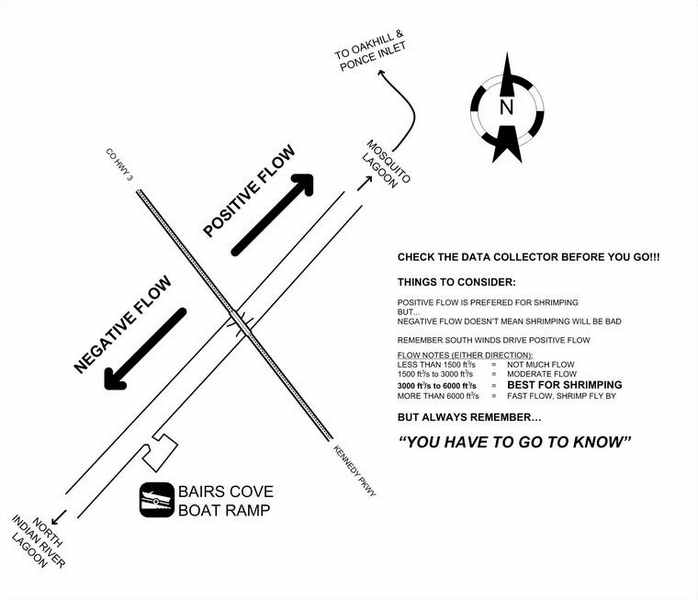
You have to monitor the Flow Speeds Website (click link).
- Positive flow moves from a swollen Indian River in Brevard toward Mosquito Lagoon. This happens with a South wind from a low-pressure system exiting Florida into the Atlantic. (West to East).
- Negative flow is from Mosquito Lagoon, passing through Haulover Canal into Brevard County (East to West)
- Flows should be 2000-4000; anything greater is too strong. For reference, 3000 flow is walking speed. A negative flow is indicated by a minus sign in front of the flow amount.
- You must have a FWS refuge permit (click here)
- Best spots are NOT by the bridge; the closer to the bridge, the faster the water and the more turbulence issues. Bridge tenders will swat at you if you’re too close to the bridge in the travel lane.
- Rip lines merge behind the bridge, fast currents, and concentrate the shrimp like the channel edges, due to Oak Hill shrimpers. This is where the slow water meets the fast channel water.
- Need extra weight; run your lights down the anchor line; do not set on the bottom. Heavy grass at times, but shrimp hitch rides on the grass. Red grass is the most hated because it dims the lights and clogs the clogs on anchor lines.

2. Titusville Veterans Memorial Fishing Pier
As Brevard County’s premier destination for land-based shrimpers, the pier demands strict preparation, specialized adapters, and close attention to the weather.
- The Atmospheric Trigger: The absolute best time to fish the pier is during a strong North wind. A strong north wind pushes surface water down the Indian River Lagoon, creating a powerful current that forces shrimp off the flats and carries them past the pier, making them prime targets for a hand-dropped dip net.
- The Nightly Rail Lottery: Because the pier is incredibly popular during peak season, you cannot simply show up and take a prime spot along the rail. To maintain order and fairness, the county operates a mandatory nightly spot lottery at 6:00 PM. Shrimpers draw numbers to secure their designated fishing sections for the evening.
- The Special Twist-Lock Adapter: The pier provides structural convenience by supplying 120V electrical power directly on the rail to run high-intensity shrimping lights. Standard household plugs will not fit. To utilize this power, you must purchase a special twist-lock plug adapter ahead of time at a local outlet like Titusville Ace Hardware or Home Depot to adapt your lights to their specialized receptacles.
- Weekend Crowd Dynamics: When the shrimp are running thick, both the North and South pier sections get packed elbow to elbow. If you prefer room to work your net and want to avoid tangled lines, steer clear of the weekends entirely and focus on weekday nights.
- The Summer/Fall White Shrimp Run: During the transitional months of summer and fall, the pier experiences heavy runs of massive, select 7-inch-plus “white” shrimp. These giant crustaceans are easily distinguishable by their vibrant blue/green tails and move through the lagoon in massive, highly concentrated bands.

3. The Railroad Bridge (Titusville)
For boaters, the old NASA Railroad Bridge offers an exceptional structural ambush point, but navigating its tight quarters requires precision positioning and an understanding of piling physics.
- The Launch and Setup: Launch from the Parrish Park boat ramp and head directly to the bridge. Get there early to claim a “cubby hole” because this place fills up fast. Expect to fish in very close quarters with your neighboring boaters.
- An East-to-West, Wind-Driven Outcome: The Railroad Bridge structurally spans directly from East to West. There is no natural tide here; this area is completely wind-driven. Because of this, avoid going in a Northeast wind.
- Piling Physics & The “Dip Zone”: Anchoring tight to the pilings is a legendary tactic because the concrete columns break up the main current. When migrating shrimp hit these solid pilings, they lose their bearings, break school formation, stall out, and scatter. This structural disorientation creates a concentrated “dip zone” right next to your boat, where shrimp will run in all directions among the redfish in your light field.
- The Two-Light Strategy: Run at least two shrimping lights underneath the bridge structure. This creates a wide, interconnected glow zone that lets you track, spot, and scoop shrimp the moment they bounce off the concrete and scatter into the illuminated water column.
- The Gear Trap: Bring a spare anchor to this location—the bridge’s bottom structure notoriously eats metal. The fender spots are the most popular and highly contested shrimping positions on the bridge.
- Zero Tidal Constraints: Dipping at the bridge lasts from dark until sunrise. Because the water movement is entirely wind-driven and not restricted by a 6-hour tidal drop, you can fish all night.

Note: Anglers come early and fish the fenders for trophy-size black drum & redfish (50+ lbs) on 100lb test line. Brevard is known as the Anglers’ Magic Kingdom, where hunting can be magical or cruel.

4. Haulover Canal Navigation, Regulations, & Safety
Hands down, Haulover Canal (28°44′11″N 80°45′17″W) is one of the most magical real estate areas in Central Florida. However, its tiny footprint accommodates roughly 50 total boat spots, with only 15 premium locations. It features heavy boat pressure, territorial anglers, tight quarters, and summer bugs so massive you could saddle them. It is a true test of physical endurance.

- Mandatory Refuge Permits: Because the canal lies entirely within the Merritt Island National Wildlife Refuge, you must carry a Merritt Island Fishing Permit at all times. This permit is 100% free and is updated every January on the U.S. Fish & Wildlife Service (FWS) website. You must print it out and fill it in; laminating is highly recommended since it is thin paper.
- Refuge Ramp Fees: Launching at the Haulover Canal boat ramp, Beacon 42, or Bio Lab requires a fee (instituted in 2011). The pass costs $5 daily or $15 annually, and the funds go directly to property maintenance. Passes can be secured via the refuge website at
http://www.fws.gov/merrittisland/or by calling the refuge office at 321-861-0667. - Severe Theft and Vandalism Warning: The Haulover Canal boat ramp has a notorious history of vehicle break-ins; do not leave any valuables in your truck. The Beacon 42 ramp (located roughly 1 mile north of Haulover) is incredibly isolated and considered a high-risk area for vehicle vandalism at night. Despite the risk, many veteran shrimpers still choose to launch from Beacon 42 and run South into the canal to keep their vehicles away from the main canal crowd.
- Structural Boundary Rules: The absolute best shrimping spots in the canal are NOT close to the bridge. Bridge tenders strictly discourage “bridge huggers” from blocking or idling in the main vessel travel lane. Also, the faster the current flows, the worse shrimping gets near the bridge structure because of severe water turbulence.
- Targeting the Rip Lines: Instead of crowding the bridge, target the rip lines that merge behind the bridge in fast currents. These lines act like natural channel edges, concentrating migrating shrimp where slow structural water meets fast channel water.

5. Haulover Canal Meteorological Cycles & Data Telemetry
There is no tide in Haulover Canal—there is only flow. When the canal turns on, it serves as an early-warning indicator: we know Oak Hill will have a massive run shortly (24-48 hours after. Move Oakhill/South Lopez CM 6, 7, 8, 9A)
The Weather Machine: The Pre-Frontal Southern Window
When a low-pressure system tracks out of the west and sits over Mississippi, Louisiana, or the Florida Panhandle, it acts like a massive atmospheric vacuum. This system violently sucks in massive amounts of warm air from the Gulf of Mexico and the south.
At the same time, this intense suction pushes and nudges any high-pressure system sitting over Central Florida out to sea. Before this system arrives, this regional compression creates a powerful southerly wind direction for one or two days straight locally. This 24-to-48-hour southern wind window is your absolute green light to plan a trip to Haulover Canal. It stacks the water perfectly to generate a positive, highly productive current flow. Weak, slow-moving fronts actually create the absolute best shrimping currents at Haulover.
Cracking the Data Code: Real-Time Flow Telemetry
To know exactly when the canal is firing, you must monitor the live USGS data recorder for Haulover (USGS Station 02248380). Open Google, search “Haulover Canal Data,” and add the feed to your smartphone bookmarks. (The direct URL is http://nwis.waterdata.usgs.gov/fl/nwis/uv?dd_cd=03&format=pre&period=7&site_no=02248380 or can be linked via ://leenoga.com).
When interpreting the data recorder numbers, use the following framework:
- The Positive Flow Sweet Spot (+3000 to +4500): This is the ideal current strength for dipping. We consider +3000 to be standard walking speed. It coaxes the massive Indian River shrimp into motion heading toward the Mosquito Lagoon (West to East) without overwhelming your gear.
- The Minimum Floor (+1000): When the recorder reads at least +1000 positive, the canal has officially turned on.
- The Danger Velocity Ceiling (+6400): Anything reading over +6400 means the current is moving far too fast to fish effectively. Currents over +4000 are highly dangerous for anchoring a boat sideways.
- Negative Flow (The Mosquito Run): If the data recorder shows a negative number (minus sign), the current is flowing East to West (Mosquito Lagoon water pushing backward into the Indian River). While you can catch shrimp on both flows, negative flow is not a good time to shrimp because you miss out on the giant, landlocked Indian River shrimp. Always target the positive flow for true Haulover magic.
Seasonal Calendar and Gear Deployment Tactics
The magic begins in March and April (varies yearly). During this spring window, you can easily go home with a full bucket of shrimp and a full bucket of blue crabs. Because Haulover is flow-driven and non-tidal, you can often fish for up to 12 hours of total darkness. This is a massive advantage over tidal waters like the Mosquito Lagoon, where you are strictly limited to a maximum 6-hour window of outgoing tide.
However, deployment in these heavy flow conditions requires adjusting your gear:
- Light Rigging: Managing your shrimping lights in a ripping canal current can be a major pain. To keep them stable and prevent them from swinging wildly, run your lights directly down your anchor scope line.
- Anchor Weight: You will need significantly extra anchor weight and a much longer anchor scope line to keep your vessel pinned when currents cross the +3000 threshold.
- The Frame Net Danger: The canal frequently suffers from heavy floating grass issues—particularly red grass, which is universally hated because it clogs lines and dims your light field. Because shrimp will actively ride on top of these heavy floating grass mounds, a frame net is a terrible idea. Furthermore, if the current drops below your sweet spot and weakens, do not deploy a frame net; without enough current velocity to pin them against the mesh, the shrimp can literally turn around and walk right back out of the frame.
6. The Post-Frontal Clocking Sequence
After the pre-frontal low-pressure system passes, the wind rotates clockwise in a predictable way that completely flips the canal’s dynamics.

9. Hook-and-Line “Trophy Size Redfish” Canal Tactics: Capt Lee Noga Baited with Black Eels
When you aren’t dipping shrimp, Haulover Canal is a premier destination for giant Redfish. To target them successfully, use a strict live-bait hierarchy and flawless presentation in heavy currents.
The Canal Bait Hierarchy
- Fresh Crabs (The #1 Bait): Small crabs caught fresh, or larger crabs cut completely in half, are the absolute best bait you can use in the canal. Reds love them. If they are dead or halved, fish them strictly on the bottom to let the ripping current distribute their heavy scent trail.
- Select Shrimp: A nice 5-inch or larger live lagoon shrimp is the second-best option for lines in the canal.
- Local Live Baitfish (3 to 5 inches): Anything dipped fresh and dropped directly into the canal works perfectly as a third option. Top producers include Greenies, Mullet, big Canal Ballyhoo, Croakers (“Krogers”), and Pigfish.
The Frozen Black Eel Trick – Swim right through the light fields in Mosquito Lagoon Intercoastal way during shrimp season. They are best at 7-9 inches. Larger-sized eels 3-5 feet) bite and can lacerate the skin.

A legendary local secret is to catch small American black eels (which look like little baby snakes) and hook them securely right underneath their tough lower jaw cartilage. Capt. Lee Noga caught this trophy redfish on an eel.
Once hooked, place them into a freezer bag and freeze them. Freezing makes the eel meat completely bulletproof. When you fish them on the canal bottom, the notorious pinfish (“pennies”) will not be able to peck or destroy your bait. If you fish a frozen eel all night and nothing hits it, put it back in your freezer bag and throw it back in the freezer for your next trip.
The Laws of the Current & Stealth
- The 1 to 3.5 Knot Law: Current speed is the ultimate factor in how well the canal fish bite. To “turn the light on” for a heavy predatory bite, the current must be moving between 1 and 3.5 knots. If the water rips much faster than 3.5 knots, the fish won’t bite as well. Conversely, slack or very slow tides are a complete bust on most nights.
- The Current Direction Rule: Giant Reds will bite on both negative and positive currents, but the water must be actively moving.
- Upcurrent Presentation: Cast all live baits thrown into the canal directly upcurrent to match the natural flow. Let the bait drift naturally back down toward you using a completely freelined line or just a couple of small split shots. Heavy terminal tackle will ruin the drift and spook the fish.
- Surface Feeding & Midnight Shadow Lines: On certain nights, the big Reds will sit very close to the top of the water column, feeding on bait floating in the surface film. When this happens, use a completely freelined bait with zero terminal tackle, dropping it tightly along the light-to-shadow lines.
- The Midnight Shift: The absolute best hook-and-line fishing normally occurs after midnight. This is when heavy boat traffic dies down, engine noise weakens, and big fish lose their wariness, moving into canal bottlenecks to feed heavily under the cover of darkness.